Samsung Ads
From Catch-Up to Industry leaders in TV Advertising.
Led a transformation of Samsung Ads’ interactive TV ad experiences—from replicating industry norms to defining a differentiated user-centric platform.The work focused on elevating design quality, validating ideas through research, and proving business impact.
Improving how users notice, understand, and interact with ads represented a major opportunity to increase engagement—without interrupting content consumption.
Breaking Out of Industry Parity
Project Overview
Background
1
Samsung Ads needed to evolve TV advertising beyond static, interruptive formats into experiences that felt more relevant, interactive, and valuable to both viewers and advertisers—without disrupting content consumption.
Why It Matters
We identified this as a problem opportunity through a combination of user behavior signals, advertiser feedback, and platform constraints. Users consistently disengaged from traditional TV ads (channel switching, passive viewing), while advertisers pushed for higher interaction, measurability, and performance beyond impressions. At the same time, the existing ad UI limited innovation (e.g., static formats, QR code constraints), leaving revenue and engagement unrealized.
This mattered because closing that gap—by making ads interactive, contextual, and non-disruptive—directly impacted advertiser satisfaction, user retention, and platform monetization. The Creative Canvas unlocked new ad formats, validated demand through alpha/beta interest and signed revenue, and established a scalable foundation for future ad innovation across TV, mobile, and web.
My Role
2
I owned the end-to-end design and validation of a new product-discovery pattern for interactive TV ads, partnering with product, ads strategy, and user research.
Problem Statement
3
Existing TV ad formats were visually constrained, offered limited interaction, and suffered from engagement drop-off (e.g., banner blindness, low QR scan rates). Advertisers lacked flexible creative tools to showcase products, drive action, or adapt ads to different moments in the TV viewing experience.
Creative Canvas explored a modular, interaction-first ad system that enabled dynamic formats (carousels, overlays, paused ads, dynamic QR codes) to improve engagement, expand advertiser use cases, and unlock new revenue streams—while preserving a high-quality viewer experience on Samsung TV.
Opportunity
4
Measurable Outcome
-
A securing a $15M contract commitment for the 2026 term
Enabled adoption across 8/10 advertiser verticals, exceeding historical averages, secured $15M in 2026 advertiser commitments, and demonstrated 62.5% uplift in consumer engagement through usability testing
-
Strong Cross-Industry Advertiser Adoption of New Ad Formats
Advertisers across consumer goods retail, automotive, quick-service restaurants, insurance, and financial services demonstrated strong interest in the new ad formats and signaled readiness to commit.
-
Designing for Global, Multi-Platform Reality
The solution work across:
Multiple OS, Device types, Regions (privacy, ads policy, UX expectations)Stakeholders: Ads, Platform, Legal, Privacy, AI, Engineering
Creative Canvas: Product Carousel
Design challenge
How do we expose multiple products within a single TV ad without increasing cognitive load or requiring complex remote input?
Insight & Hypothesis
From prior ad performance data and exploratory research:
Users scan visually first, then decide whether to interact
Motion can act as affordance in lean-back contexts
Too much control friction causes drop-off
Hypothesis
A lightweight, motion-led product carousel would increase product awareness and interaction without disrupting the viewing experience.
Solution Overview
Product Carousel Format
Displays multiple products within the ad canvas
Optimized for D-pad navigation
Works across advertiser verticals and creative styles
Key design principles:
Discoverable without instruction
Interruptible at any time
Scalable across brands and layouts
“Through hands-on exploration and iteration, I experimented with multiple ways to surface products within the ad experience. This process led to the discovery of the product carousel format as the most natural, unobtrusive, and effective way to showcase products while the ad is playing.”
— Design Exploration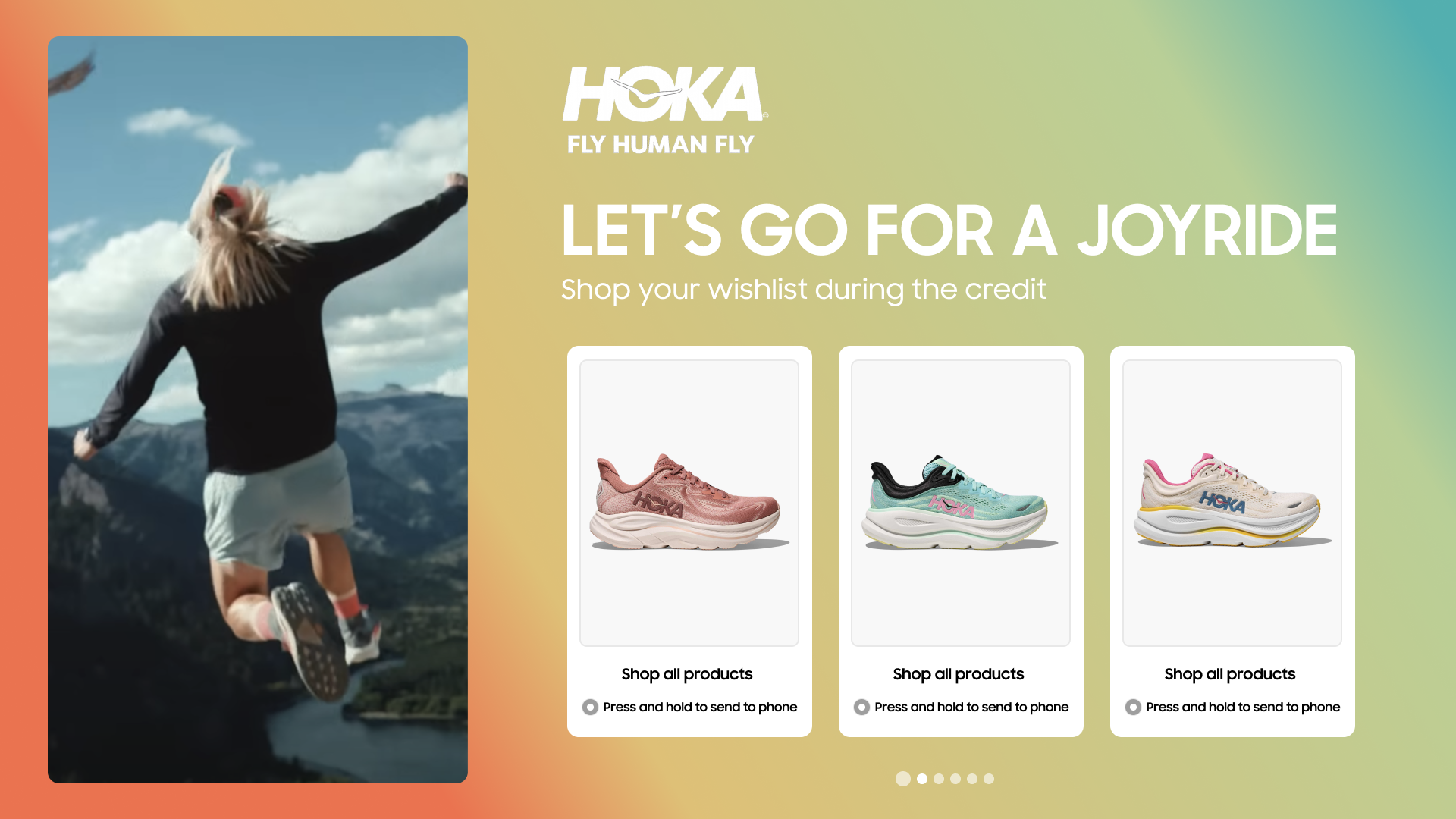
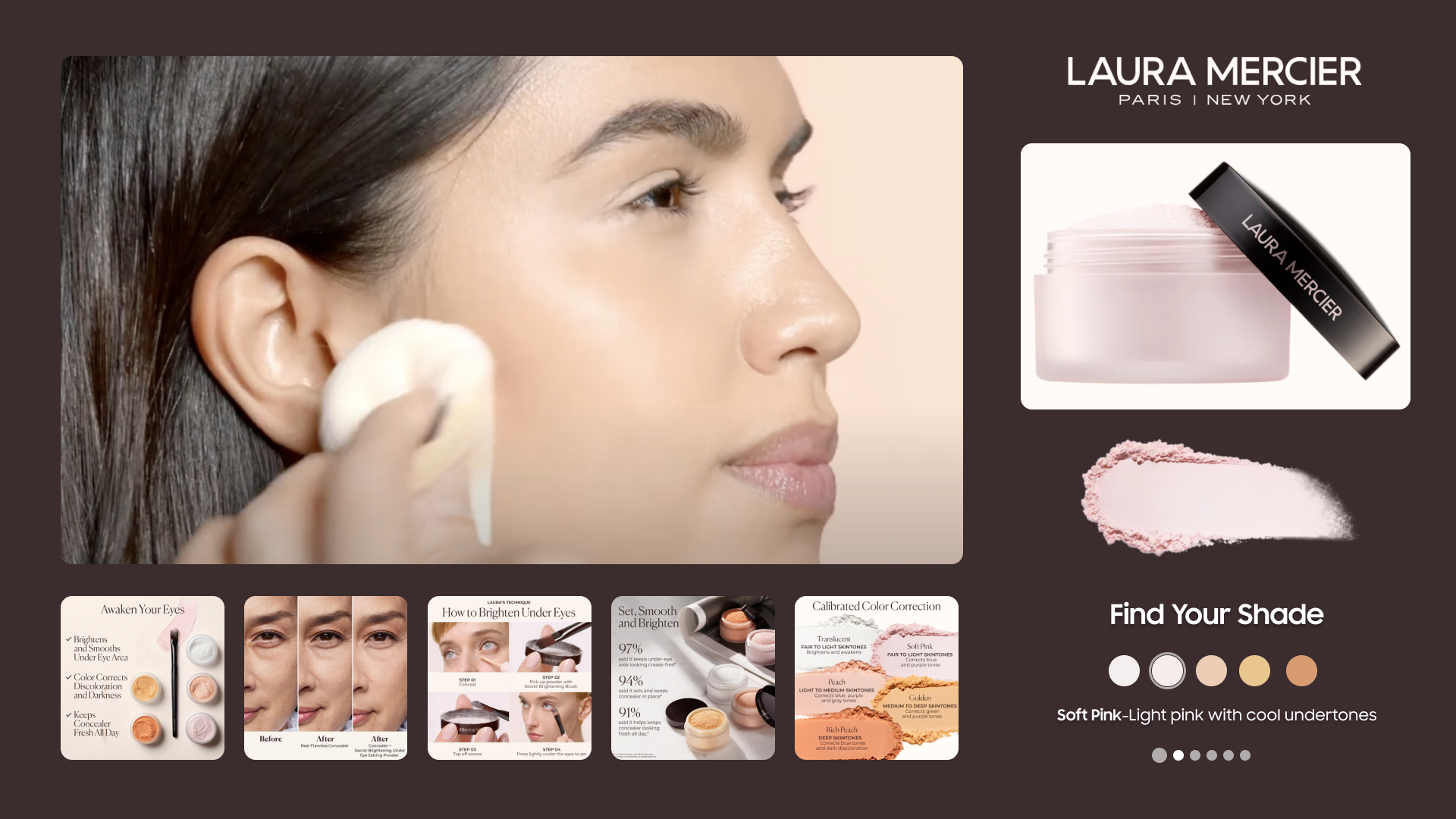
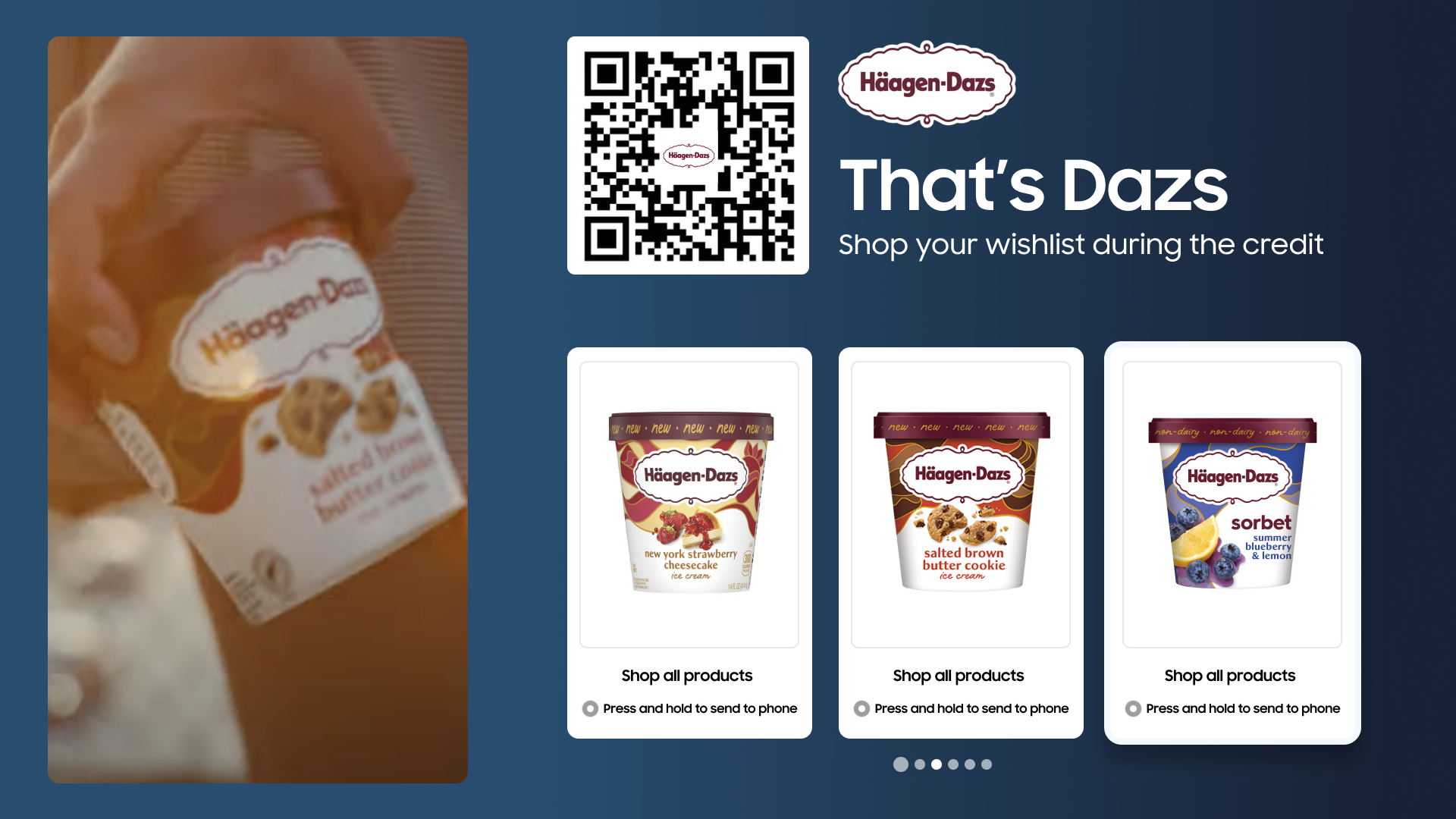
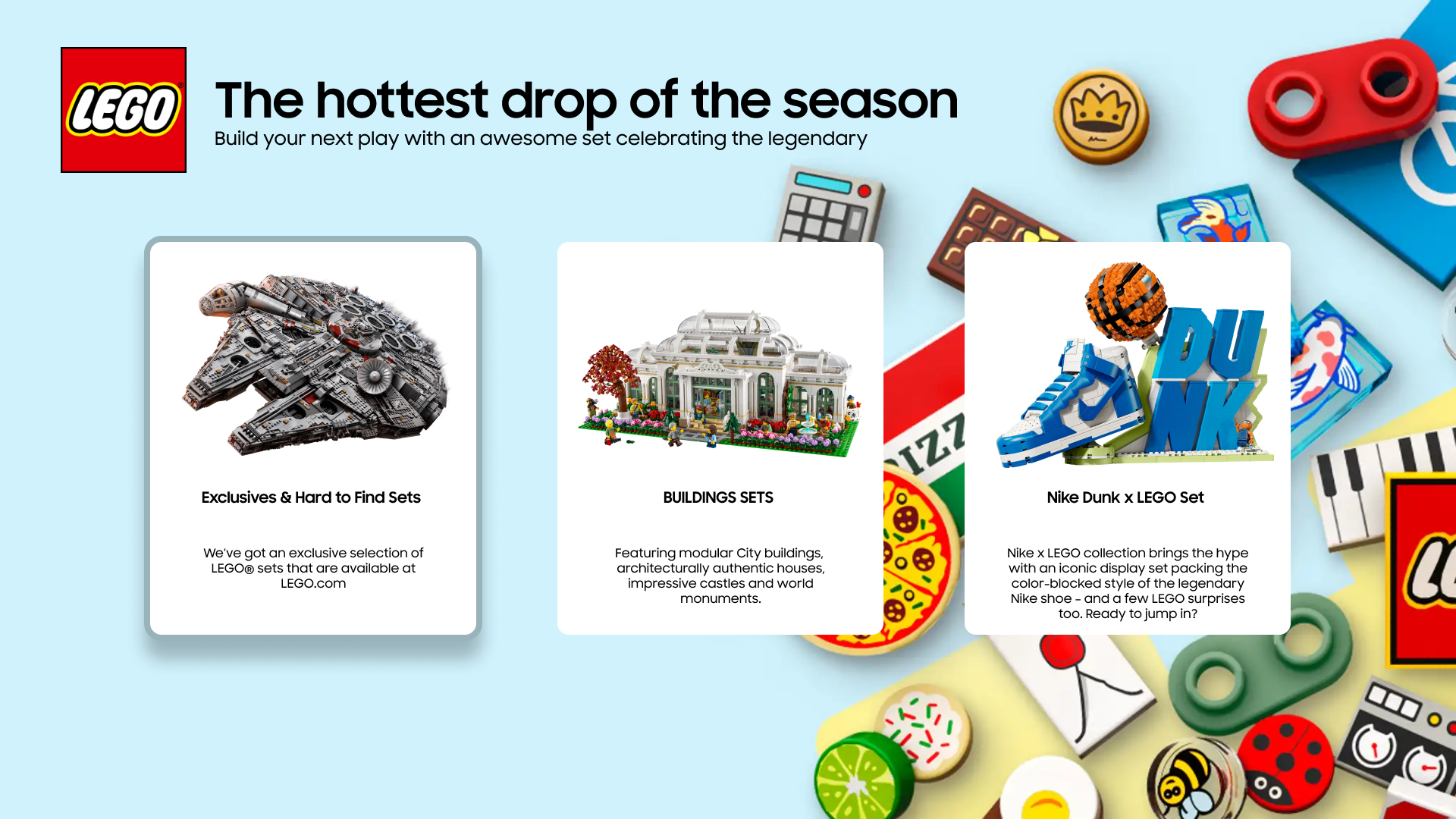

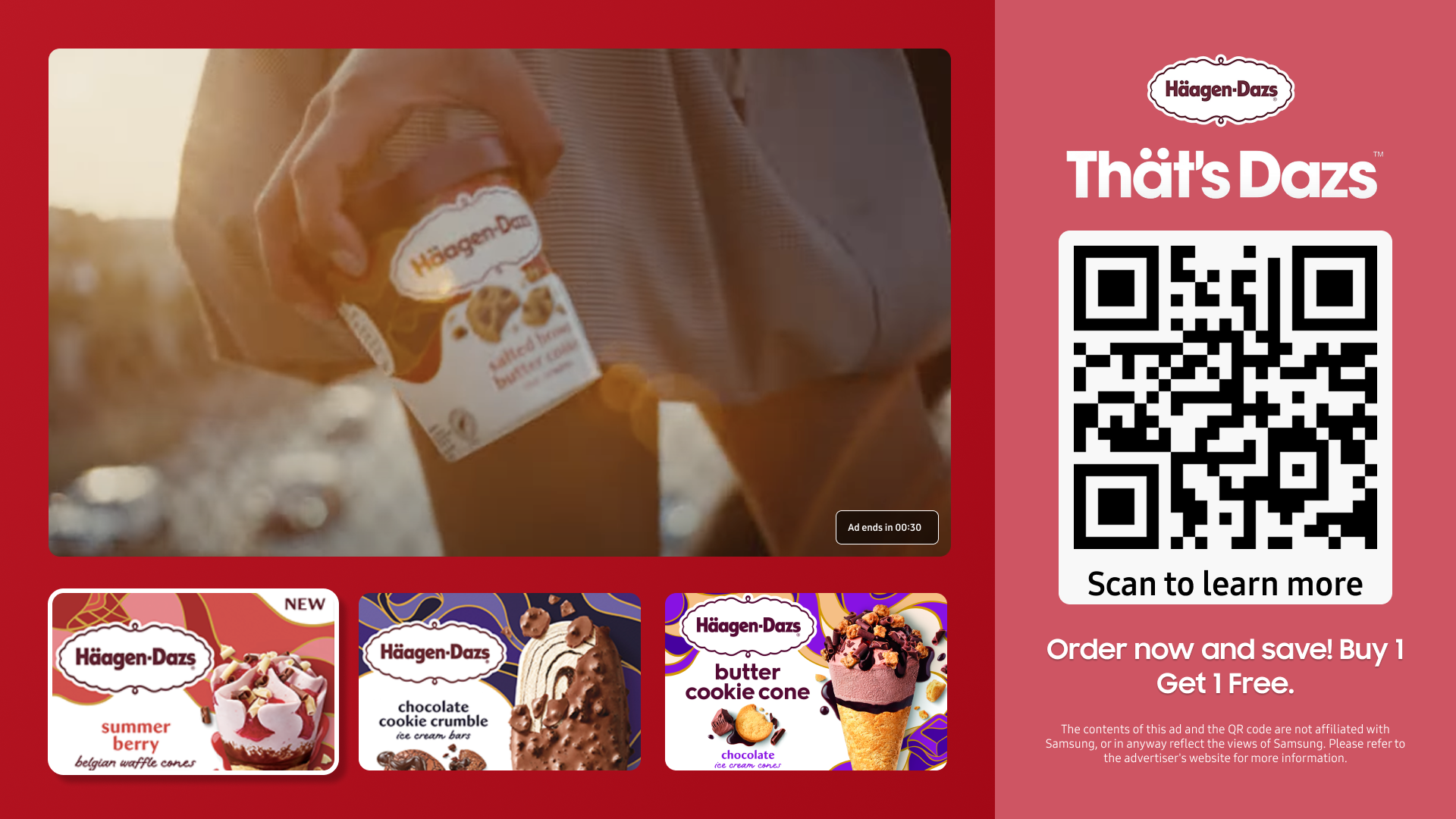
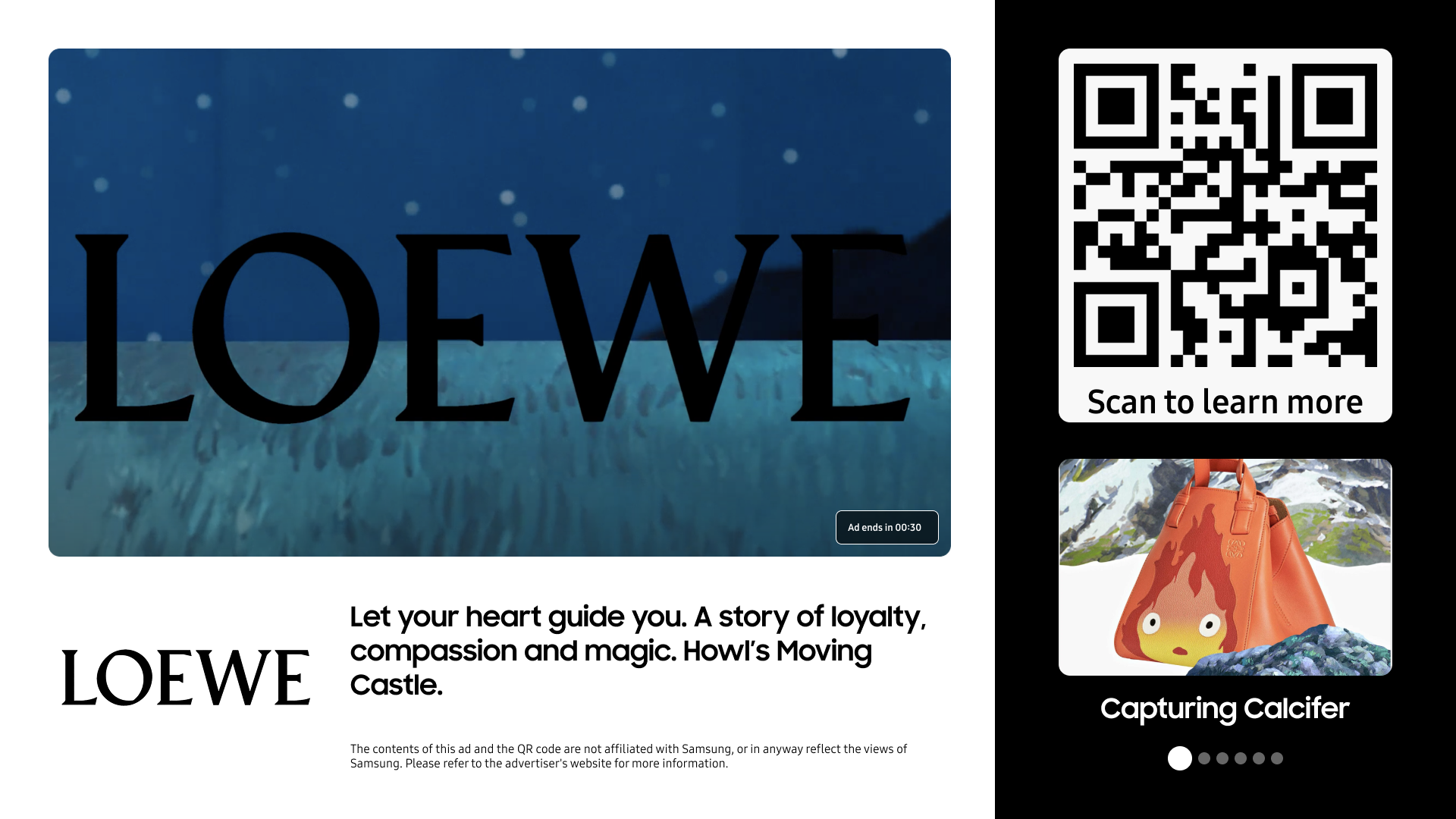
Design Exploration & A/B Testing
-
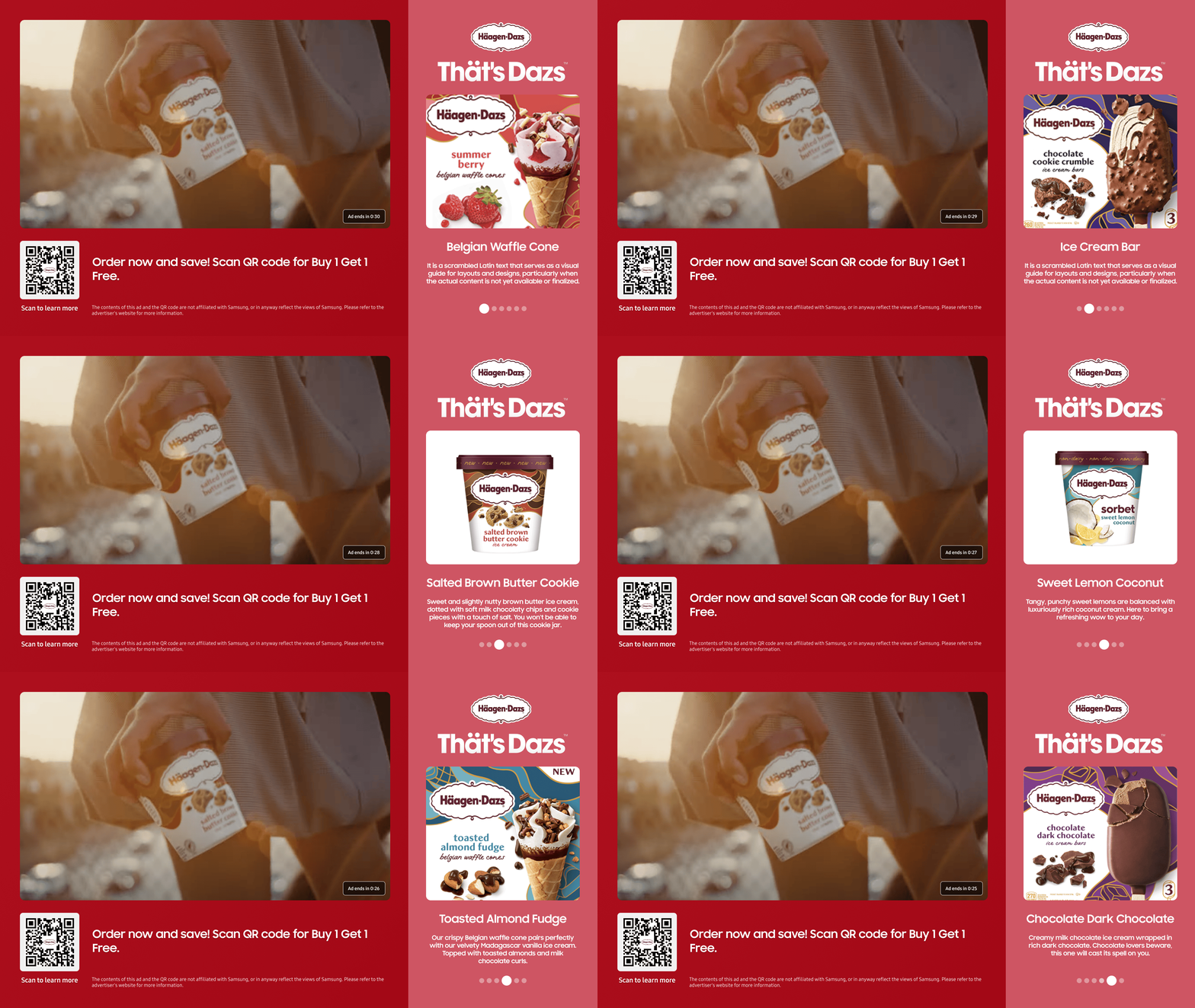
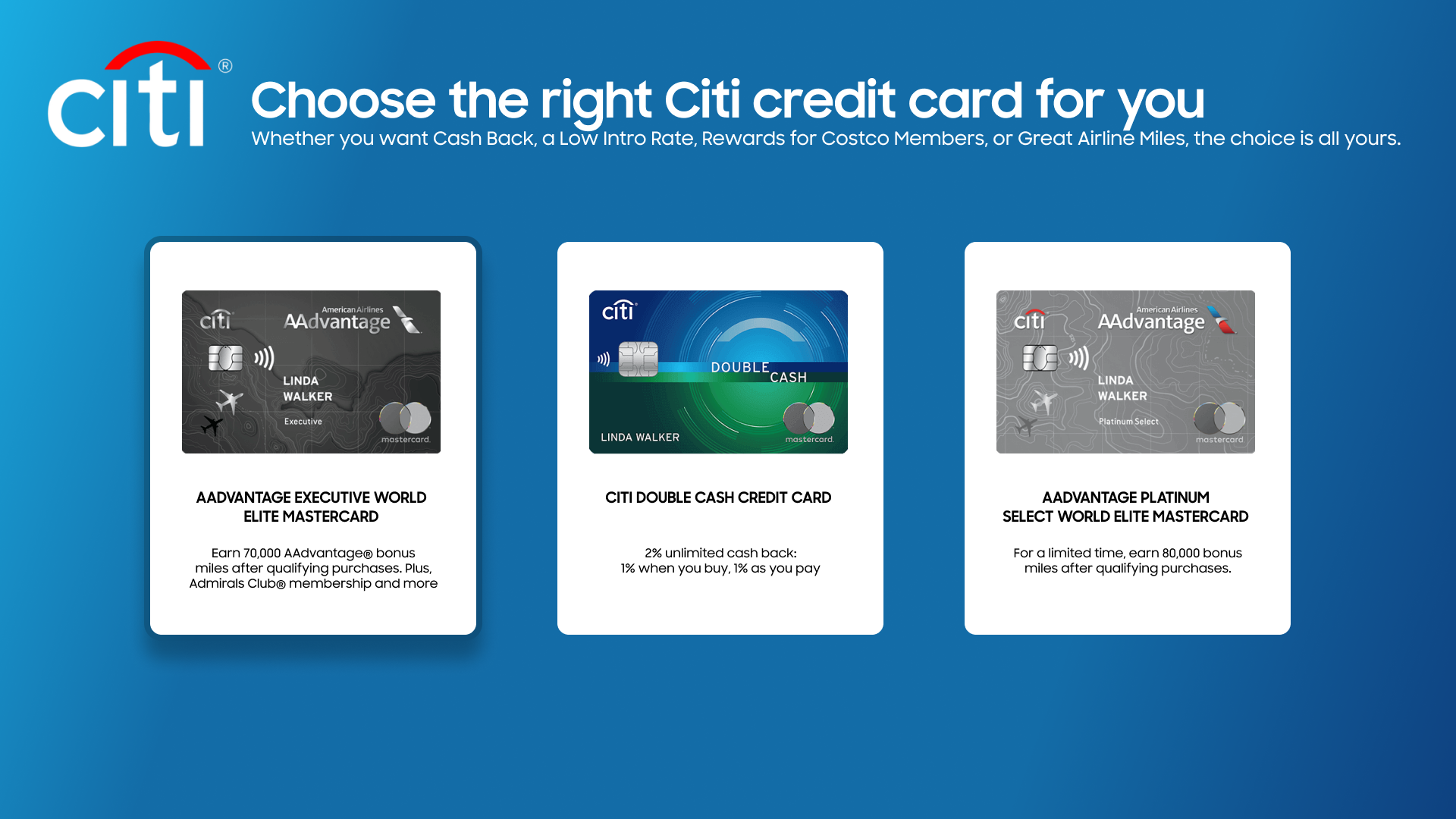
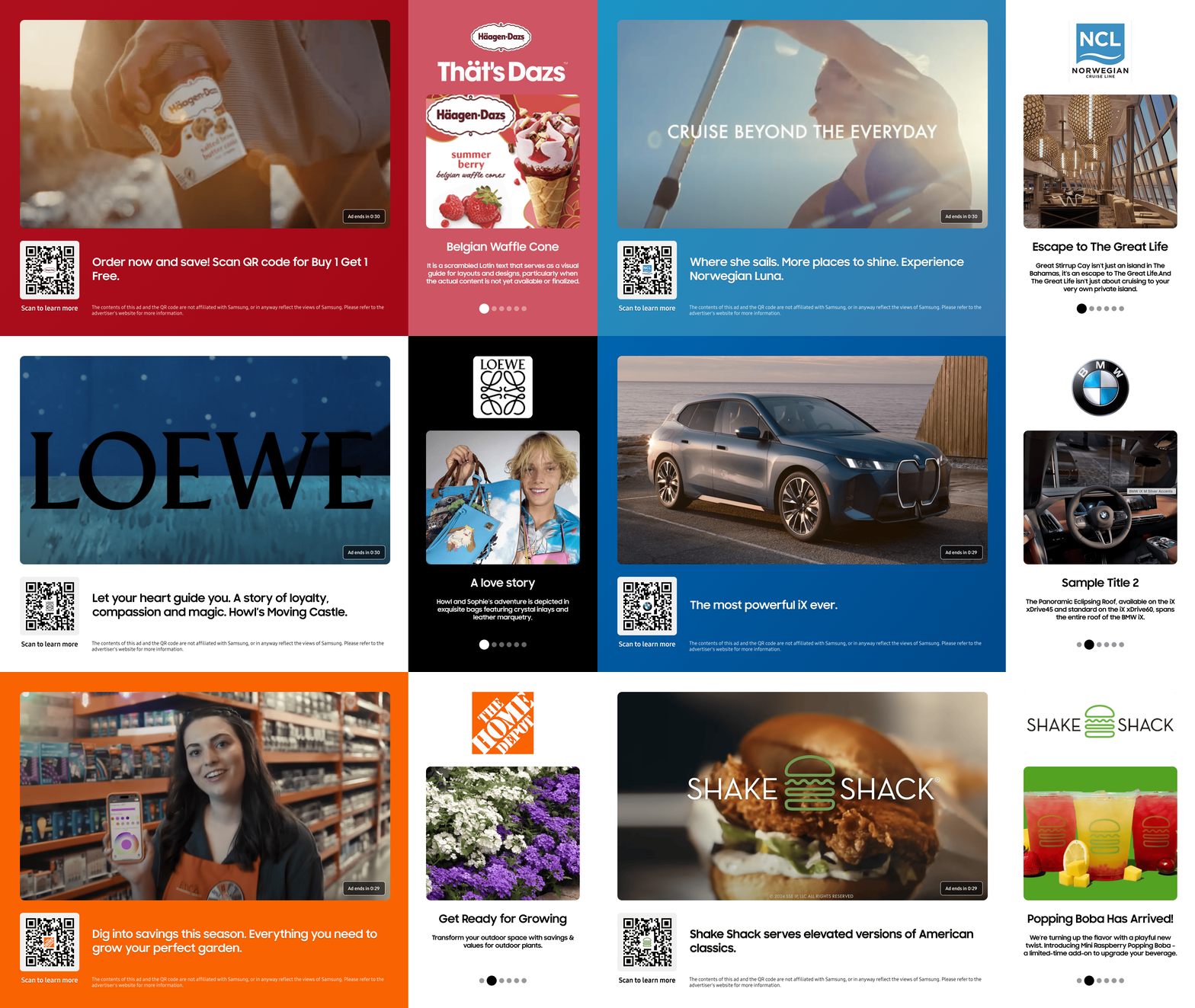
Design A - Auto-Rotating Carousel
The product carousel auto-rotates to signal that additional products are available, while still allowing users to manually override and navigate forward or backward at any time.
-
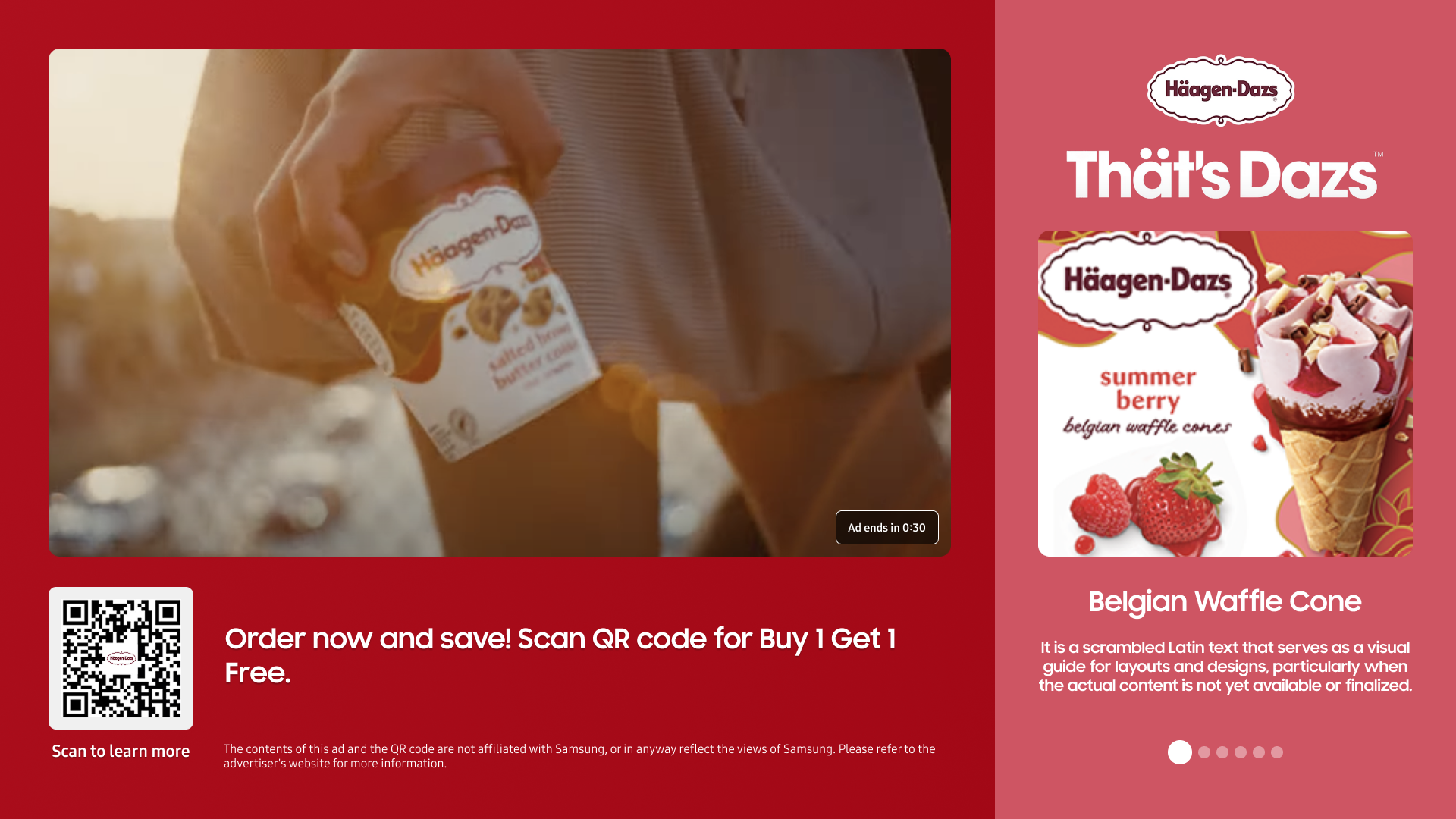
Design B - Manual Carousel
The carousel does not auto-rotate; users must use the remote’s left and right buttons to browse available products.
Research & Validation : Through moderated TV usability testing
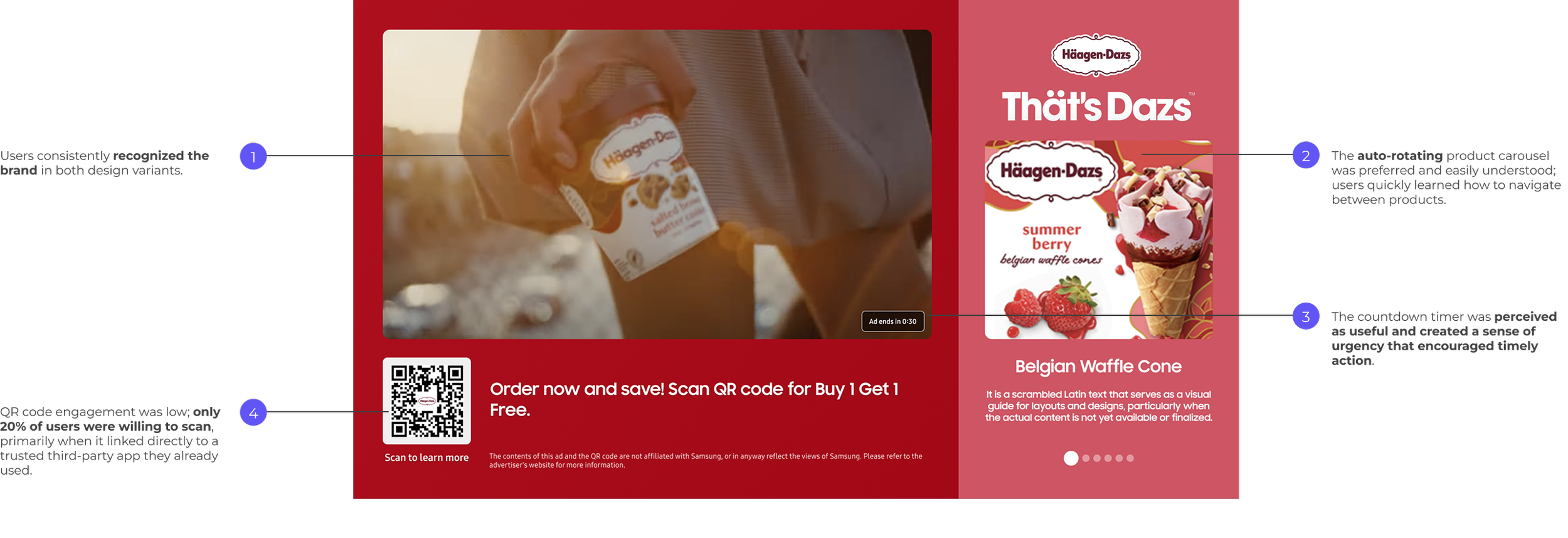
Qualitative usability testing :
interaction comprehension
In addition, user testing revealed several statistically and behaviorally significant insights that further informed design decisions.
Big Ideas, Real Impact.
In addition, user testing revealed several statistically and behaviorally significant insights that further informed design decisions. Big Ideas, Real Impact.
To move the decision forward, I:
Designed a dynamic QR prototype outside the core roadmap
Submitted the concept to Samsung’s internal Revenueathon (product-focused hackathon)
Defined consumer success metrics that would drive business metrics (scanability, layout flexibility, format unlocks)
Tested the concept in realistic TV viewing conditions
Packaged findings into a business case for leadership review
The project won 2nd place among competing revenue concepts.
At the time, there was no clear consensus to replace static QR codes. Engineering cost, timeline risk, and uncertain ROI made the proposal hard to justify within the standard roadmap.
“I recommended a dynamic QR code because it gives us flexibility and performance after launch. Unlike a static QR, we can update the destination without re-shipping the ad, measure real engagement, and optimize over time through testing. That reduces operational risk, supports attribution, and turns the QR from a one-time interaction into a scalable growth lever— which is critical in a TV and ads ecosystem”.
Replaced the static QR code with a dynamic QR system
The Revenueathon outcome provided the proof point leadership needed to greenlight the dynamic QR code as the default direction—moving the team from incremental iteration to platform-level thinking.
Business Impact–Revenue opportunity and scalable roadmap
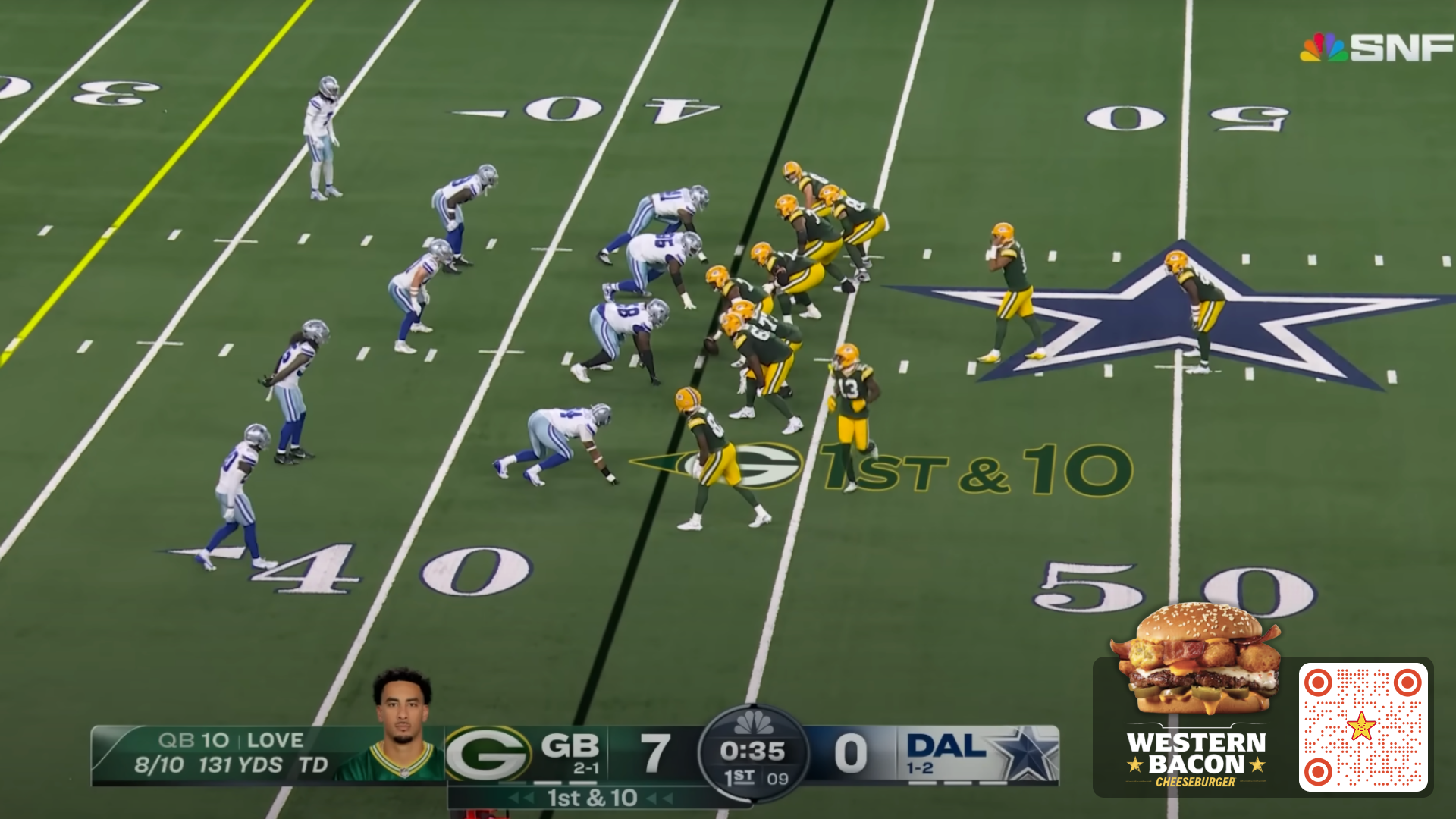
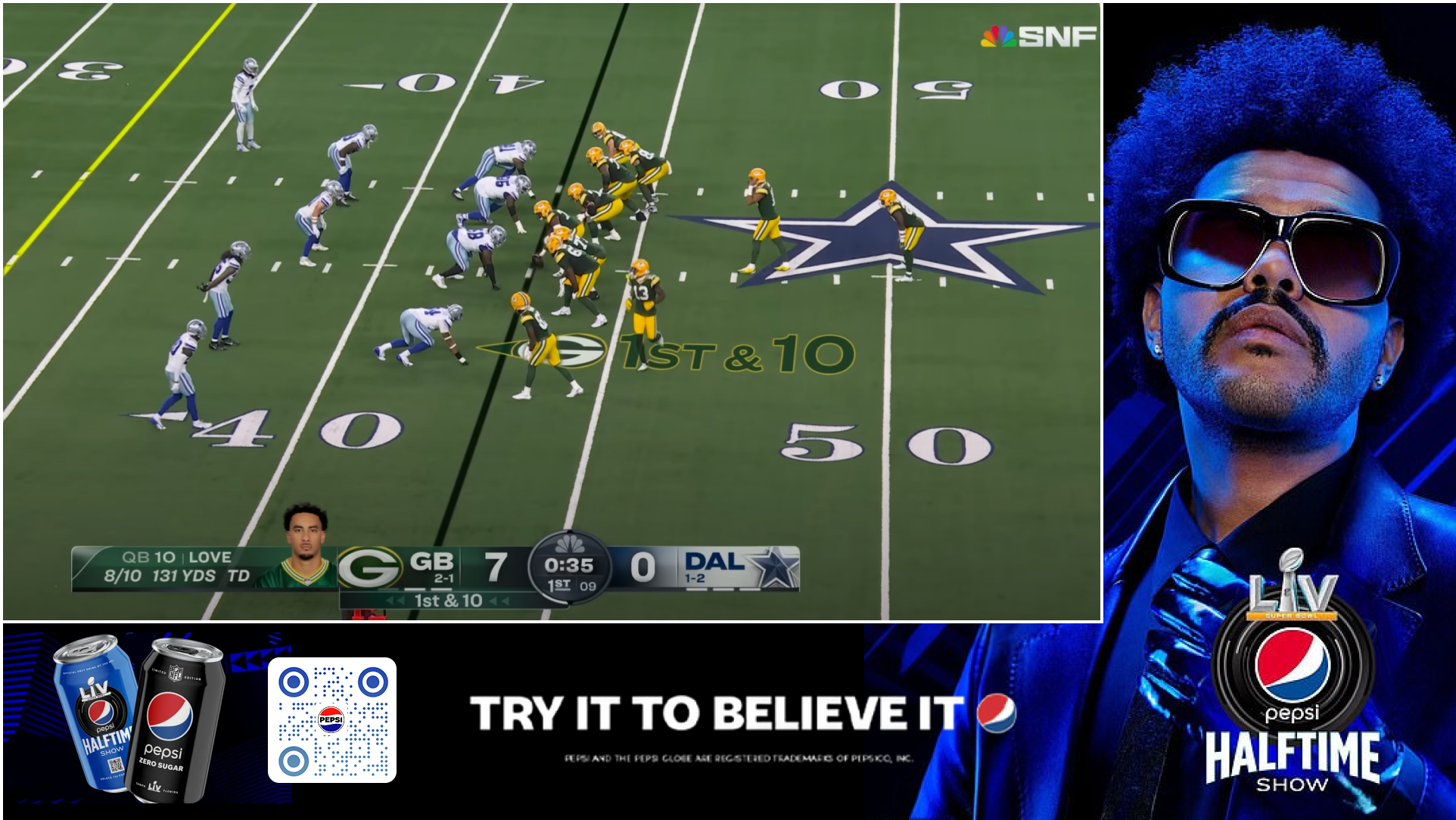
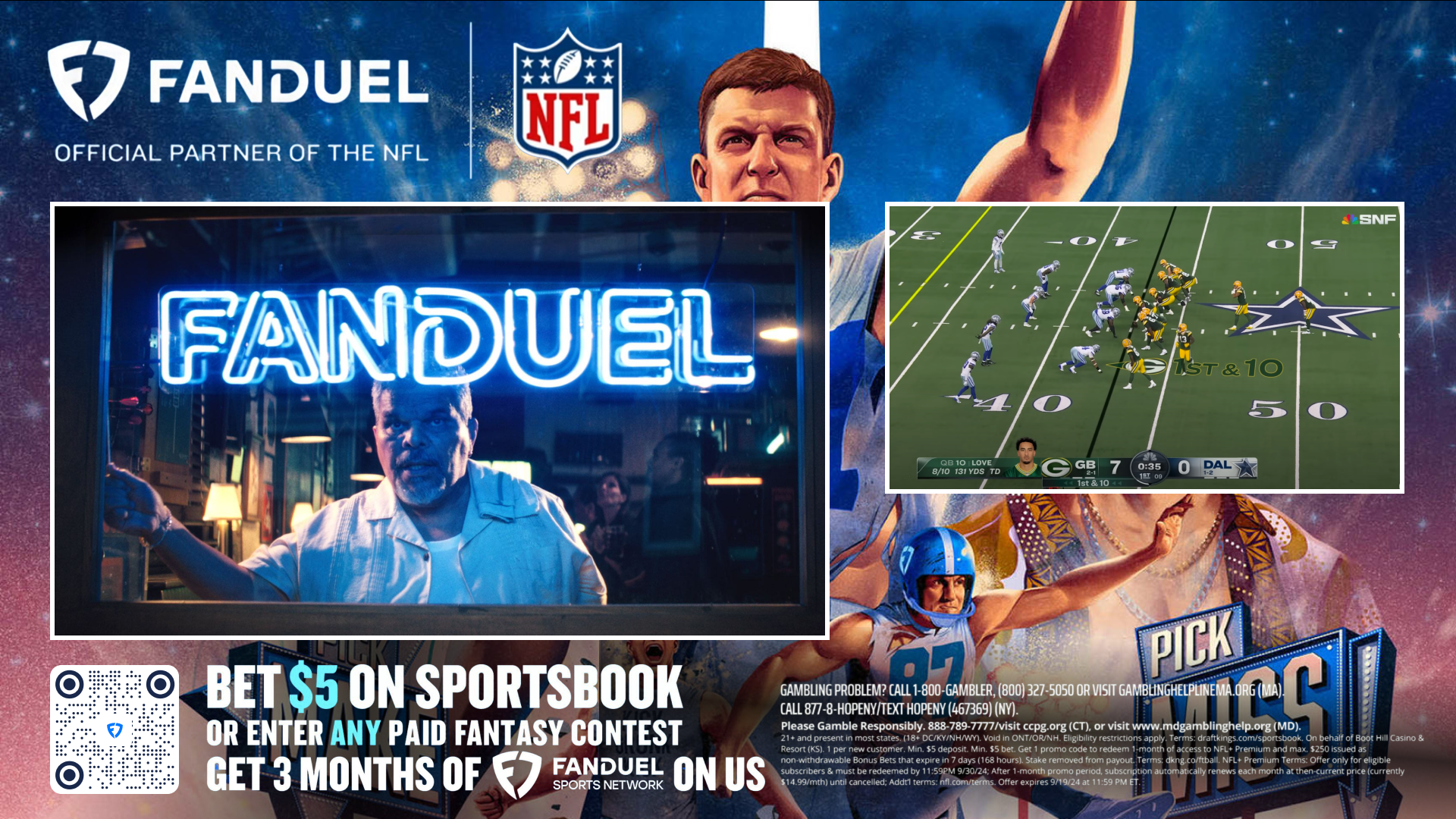
The introduction of dynamic QR codes unlocked new ad formats—including in-content overlays, squeezed ads, picture-in-picture, and interactive trivia and polls—creating incremental value for both advertisers and viewers. The work delivered clear business impact, earning executive buy-in, first place at Samsung’s internal Revenueathon, and contributing to a projected ~$15M revenue uplift.
Project:
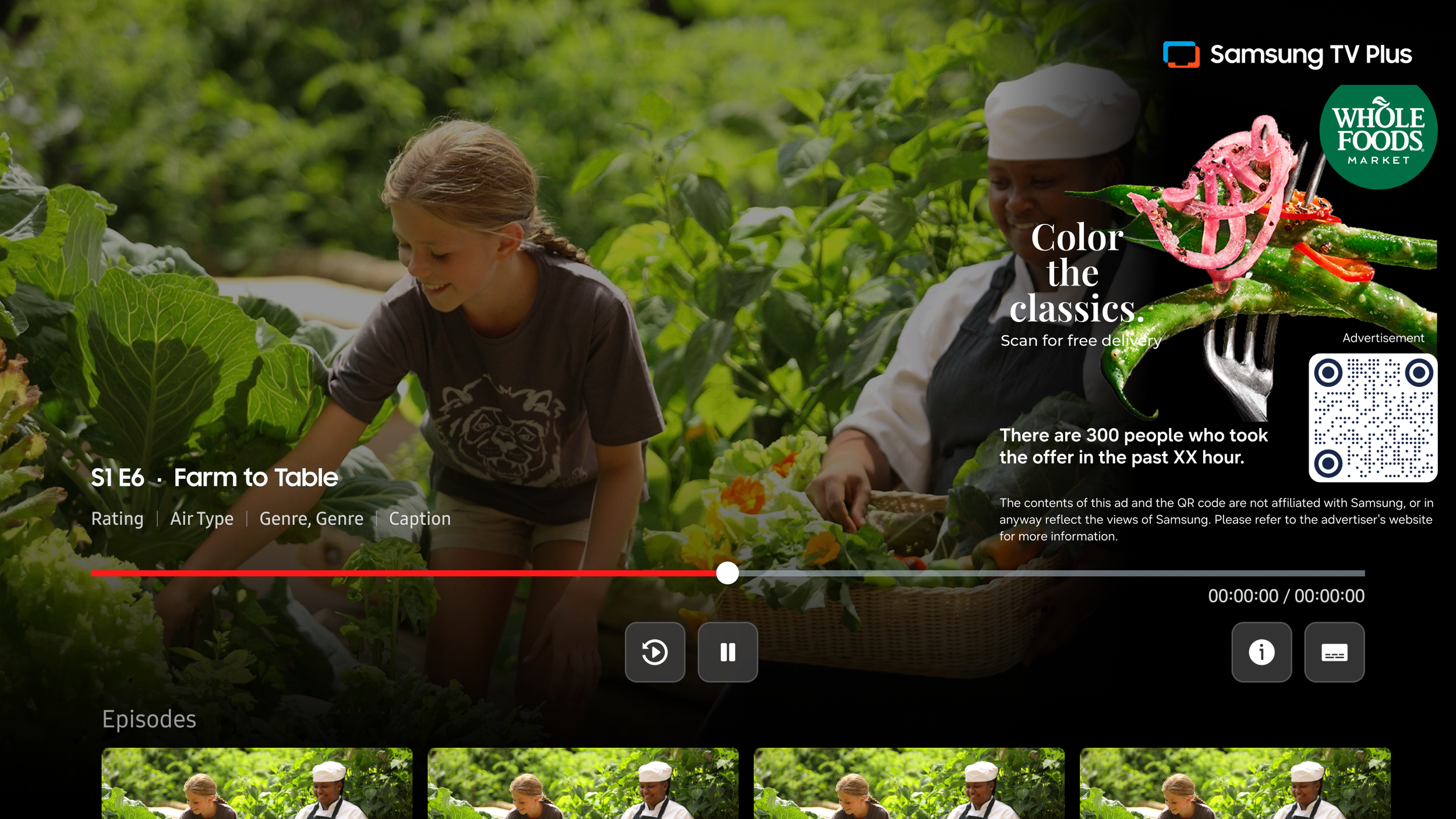
Paused Ads
Project:
In Content Overlay Ads
Project:
Squeezed Ads
Project:
Picture In Picture
“All solutions were designed to scale across TV, mobile, and web—while meeting regional ads and privacy requirements in the US, EU, and Korea”.
Measurable Outcome
-
Key Learnings
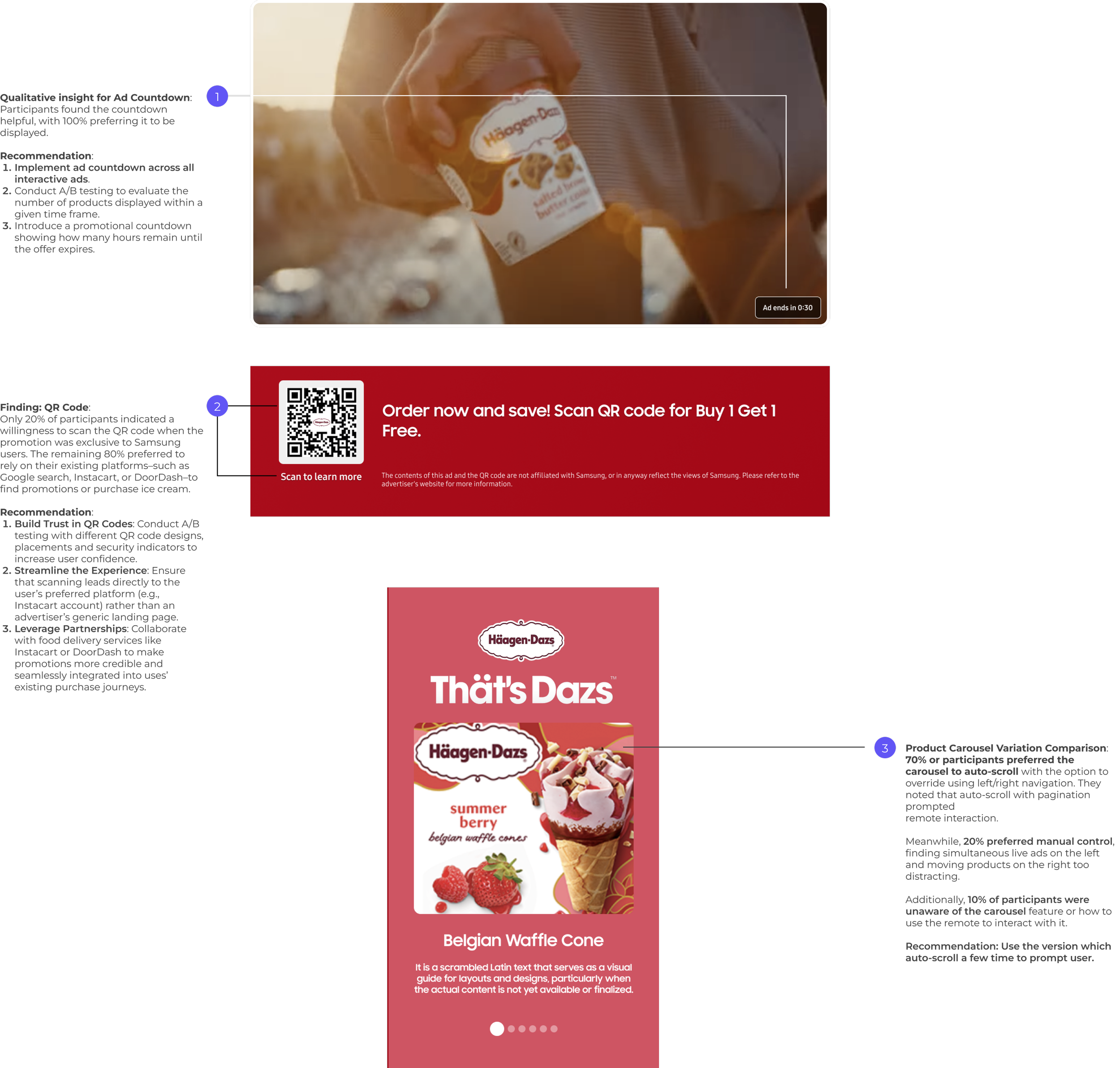
Qualitative insight for Ads Format: Across both scenarios, participants found the ad format helpful and appreciated seeing products featured during playback. This motivated them to continue watching the ad rather than leaving the room or changing channels.
Product Carousel Variation Comparison: 70% or participants preferred the carousel to auto-scroll with the option to override using left/right navigation. They noted that auto-scroll with pagination prompted remote interaction.
-
Recommendation
Implement ad countdown across all interactive ads.
Introduce a promotional countdown showing how many hours remain until the offer expires.
Build Trust in QR Codes: Conduct A/B testing with different QR code designs, placements and security indicators to increase user confidence.
Streamline the Experience: Ensure that scanning leads directly to the user’s preferred platform (e.g., Instacart account) rather than an advertiser’s generic landing page.
Leverage Partnerships: Collaborate with food delivery services like Instacart or DoorDash to make promotions more credible and seamlessly integrated into uses’ existing purchase journeys.
Product Carousel: Use the version which auto-scroll a few time to prompt user.
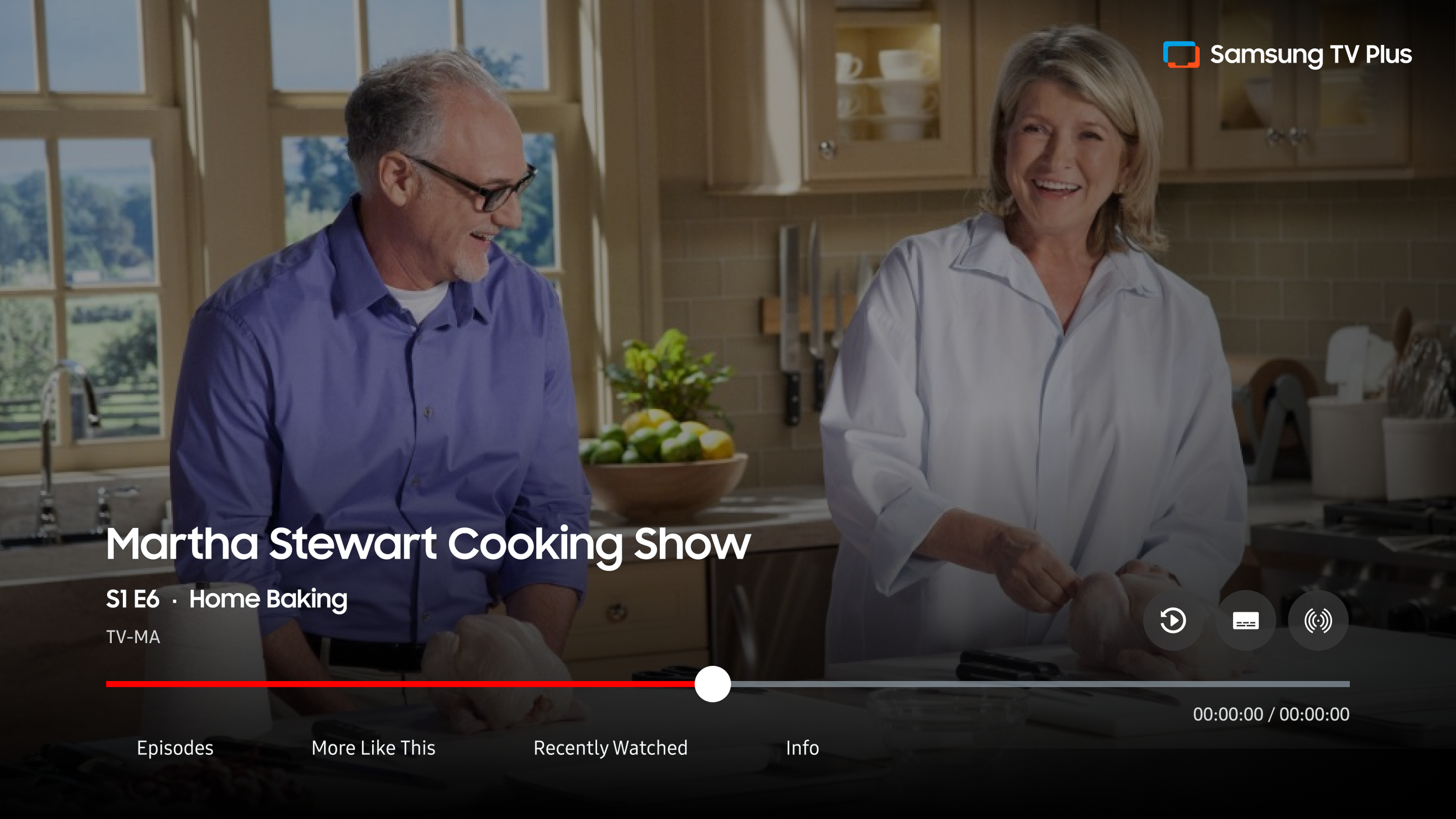
Creative Canvas – Paused Ads: Monetizing Intent Without Interrupting Content
Paused Ads introduces a new, non-intrusive advertising moment on TV—capturing high-intent attention while preserving viewer trust and content integrity.
High Ad Load Sensitivity on TV
Traditional TV ads interrupt content and reduce satisfaction. Viewers tolerate ads only when they feel contextually appropriate and non-disruptive, limiting opportunities for incremental monetization.
Project Overview
Background
1
After validating interactive formats (Product Carousel + Dynamic QR code), I identified a behavioral moment that was structurally underutilized: the user-initiate pause state.
Problem Statement
3
User Tension
Static pause screens provide no value.
Users are sensitive to ad overload on TV.
Business Constraint
Limited non-intrusive inventory.
Pressure to grow advertiser revenue without increasing ad load.
Core Question
“Can we introduce monetization at a moment of user intent without degrading trust?”
My Role
2
I owned the end-to-end design and validation of a new product-discovery pattern for interactive TV ads, partnering with product, ads strategy, and user research.
Design challenge
Can we introduce advertising during pause without degrading user trust or increasing abandonment—and can it scale globally?
Key Insight
Pausing content is:
Voluntary
Intentional
Attention-focused
Unlike mid-roll interruptions, pause moments represent a self-initiated behavioral break, which reduces perceived intrusiveness.
This reframed paused ads from an ad placement problem into a behavioral alignment opportunity.
Hypothesis
If paused ads are optional, visually restrained, and powered by Dynamic QR code for frictionless engagement, users will perceive them as contextual rather than disruptive.
Solution Overview
Paused ad experience
Triggered only when the user presses pause
Contextual creative placement
Embedded Dynamic QR Code (not static)
Immediate dismissal option
No auto-play expansion
Design principles:
Respect user control
Avoid visual dominance
Maintain content primacy
Create optional value exchange
This ensured monetization did not compromise platform trust.
From Research to Concept: Defining the Paused Ads Opportunity
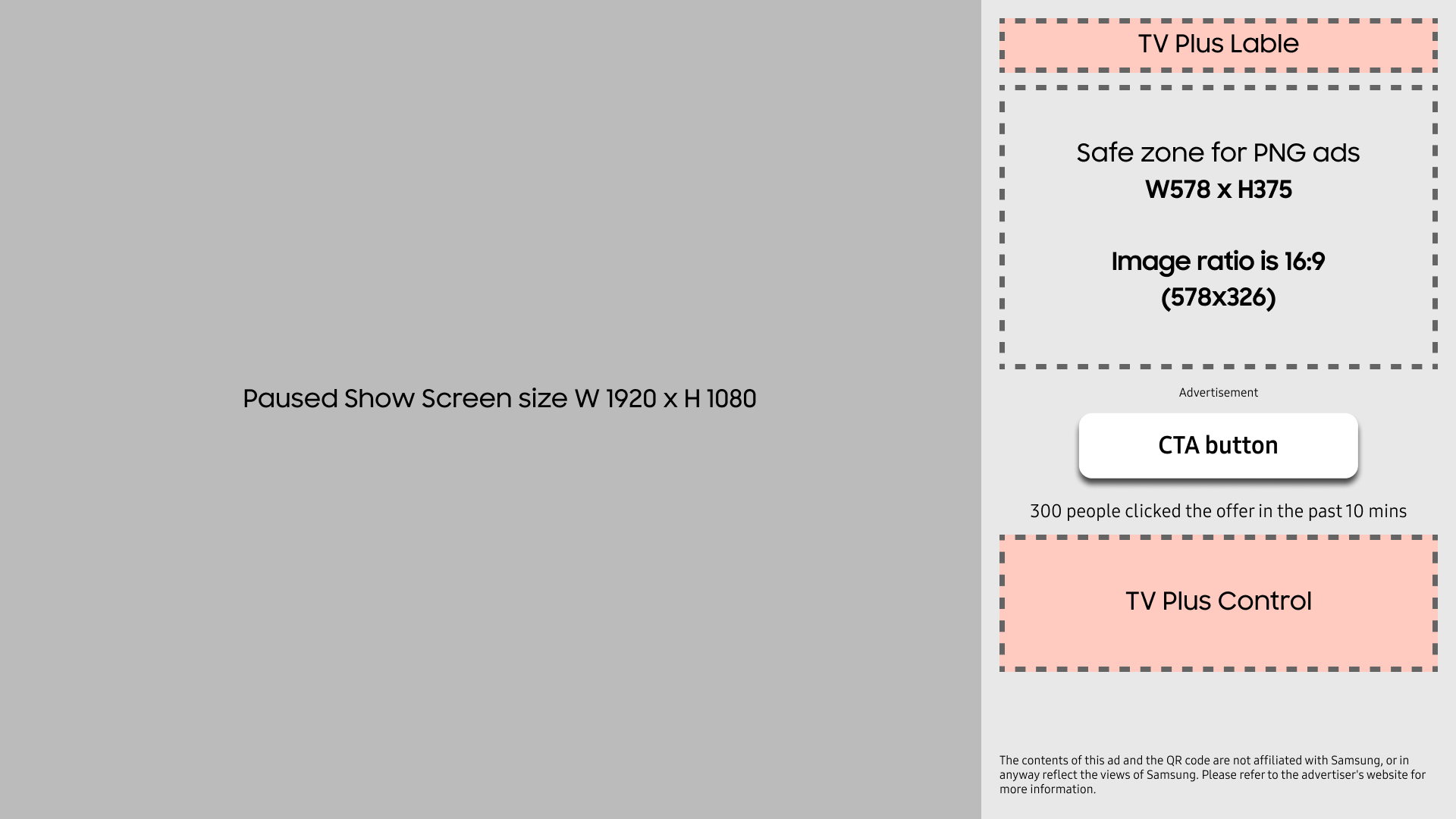
I began by researching user needs, competitive patterns, and market expectations for paused ads. I then translated those insights into rough concepts and wireframes, rapidly iterating across multiple variations to explore layout, placement, and interaction models.
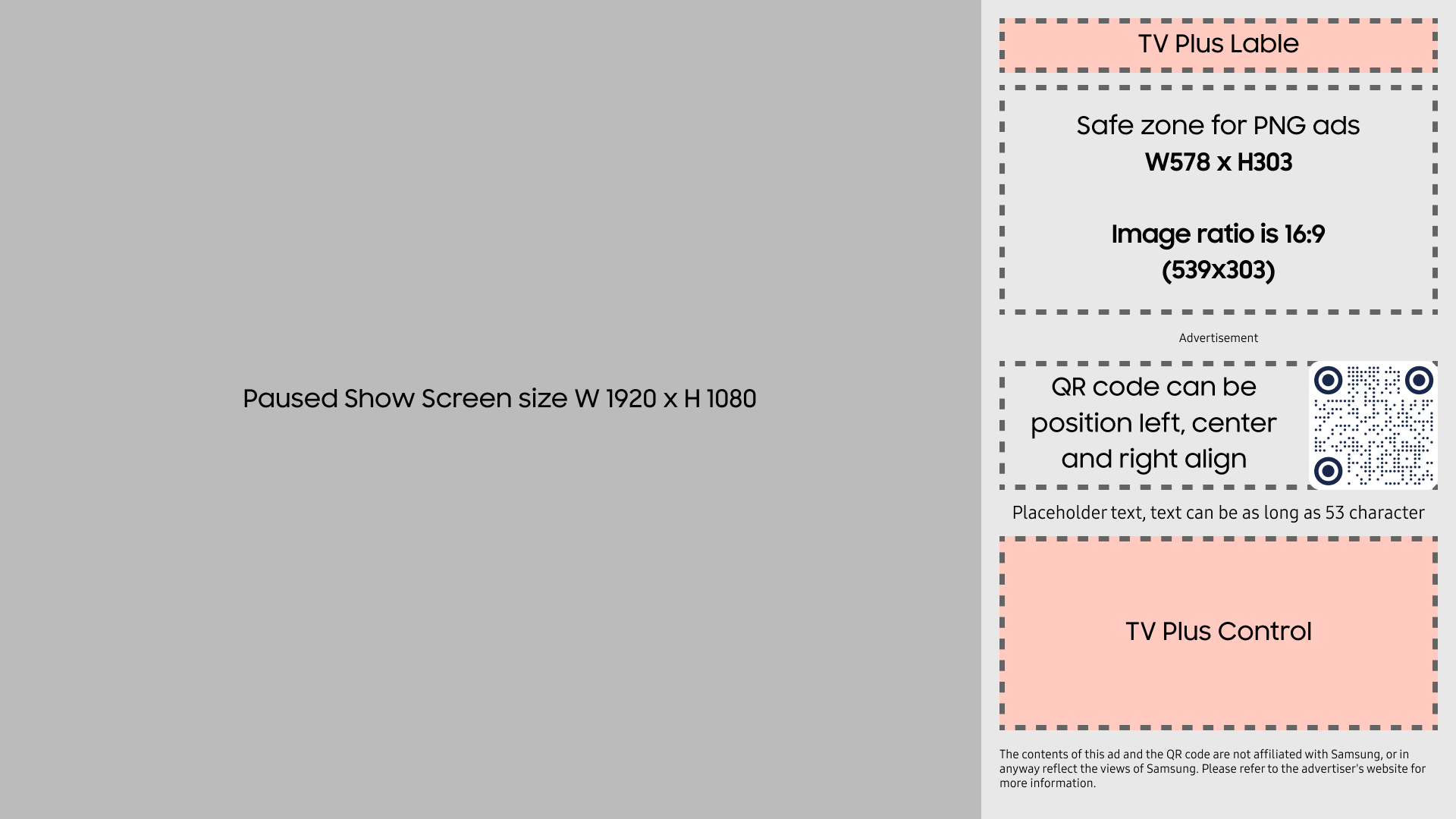
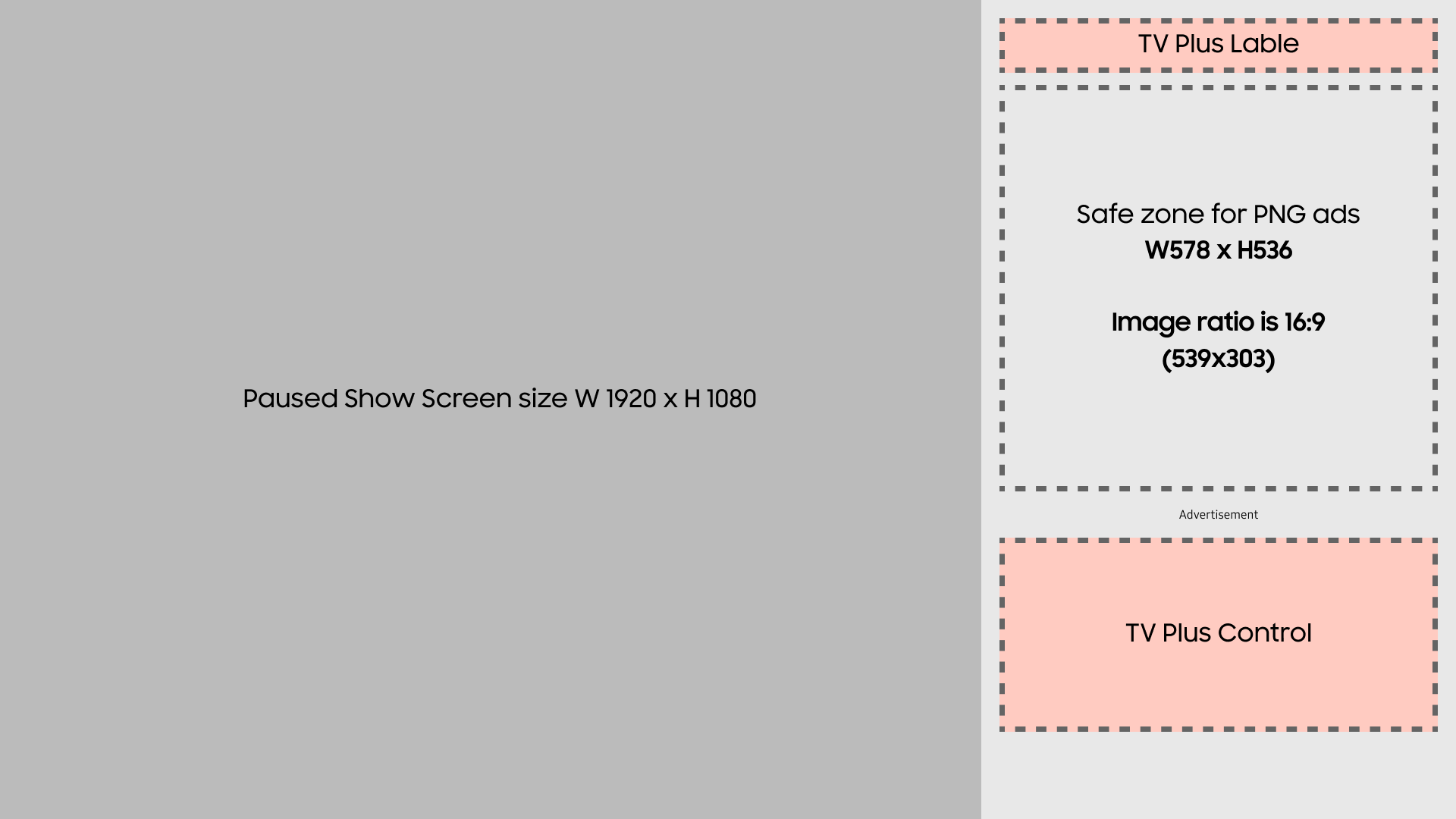
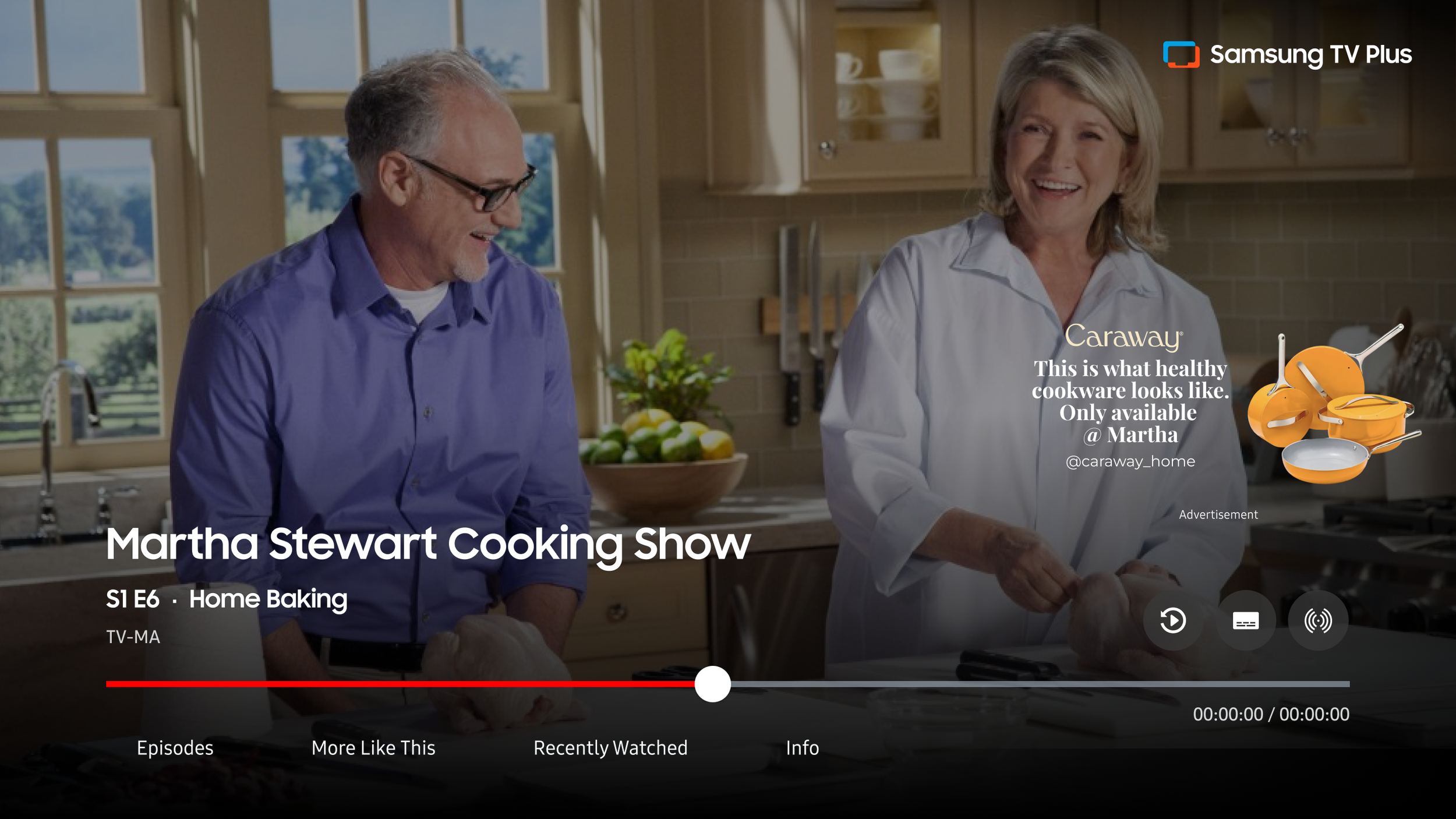
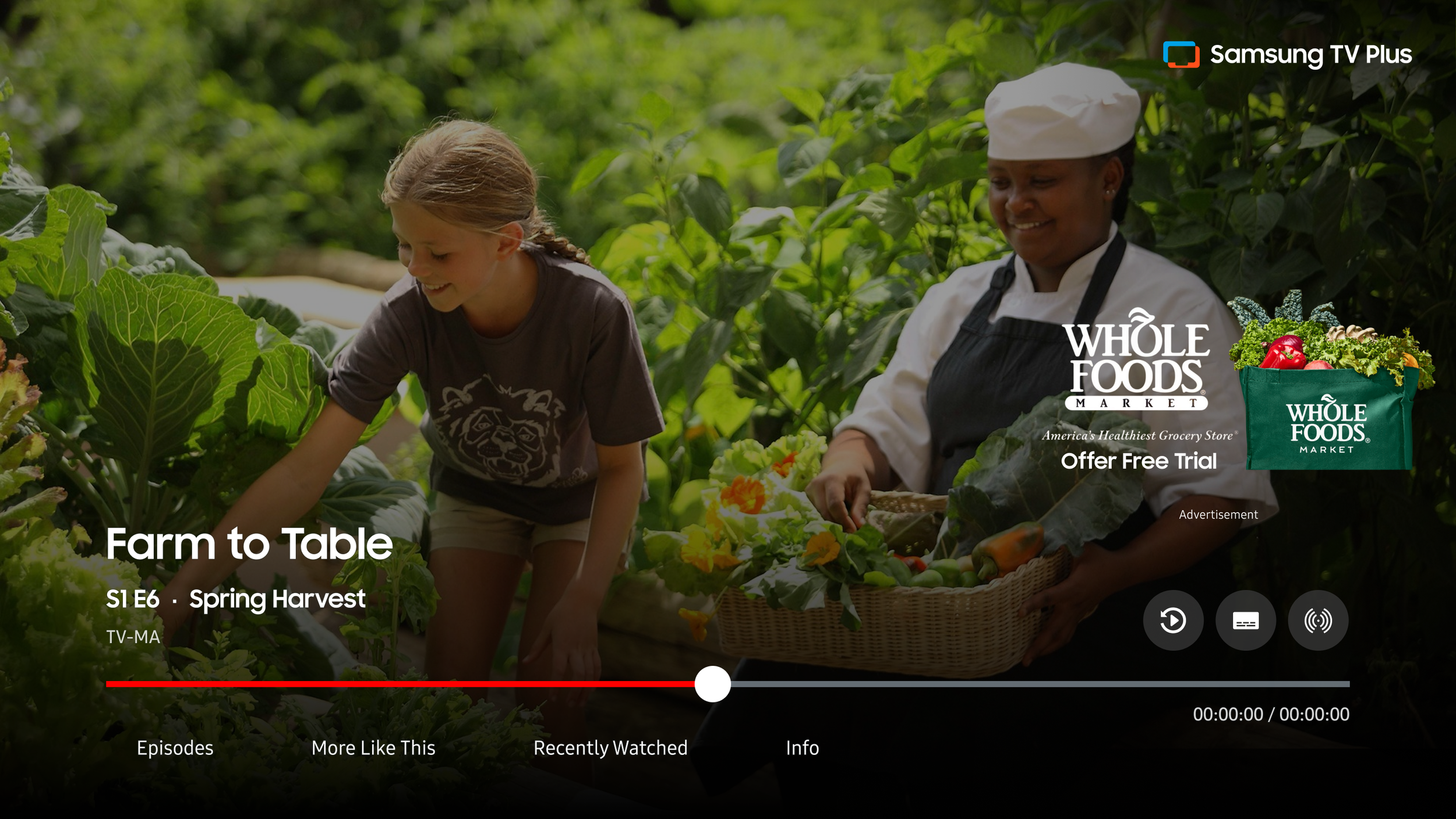
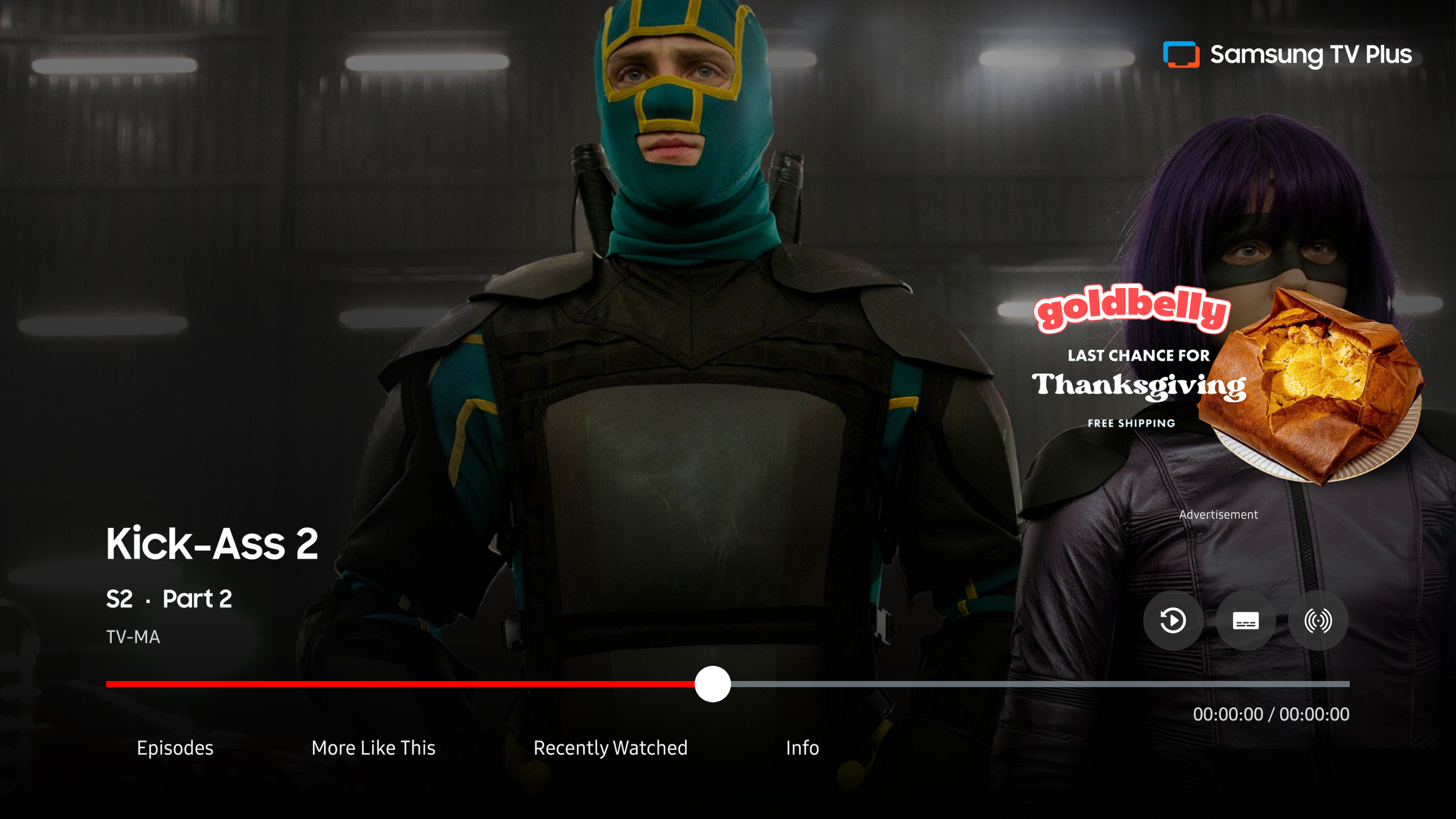
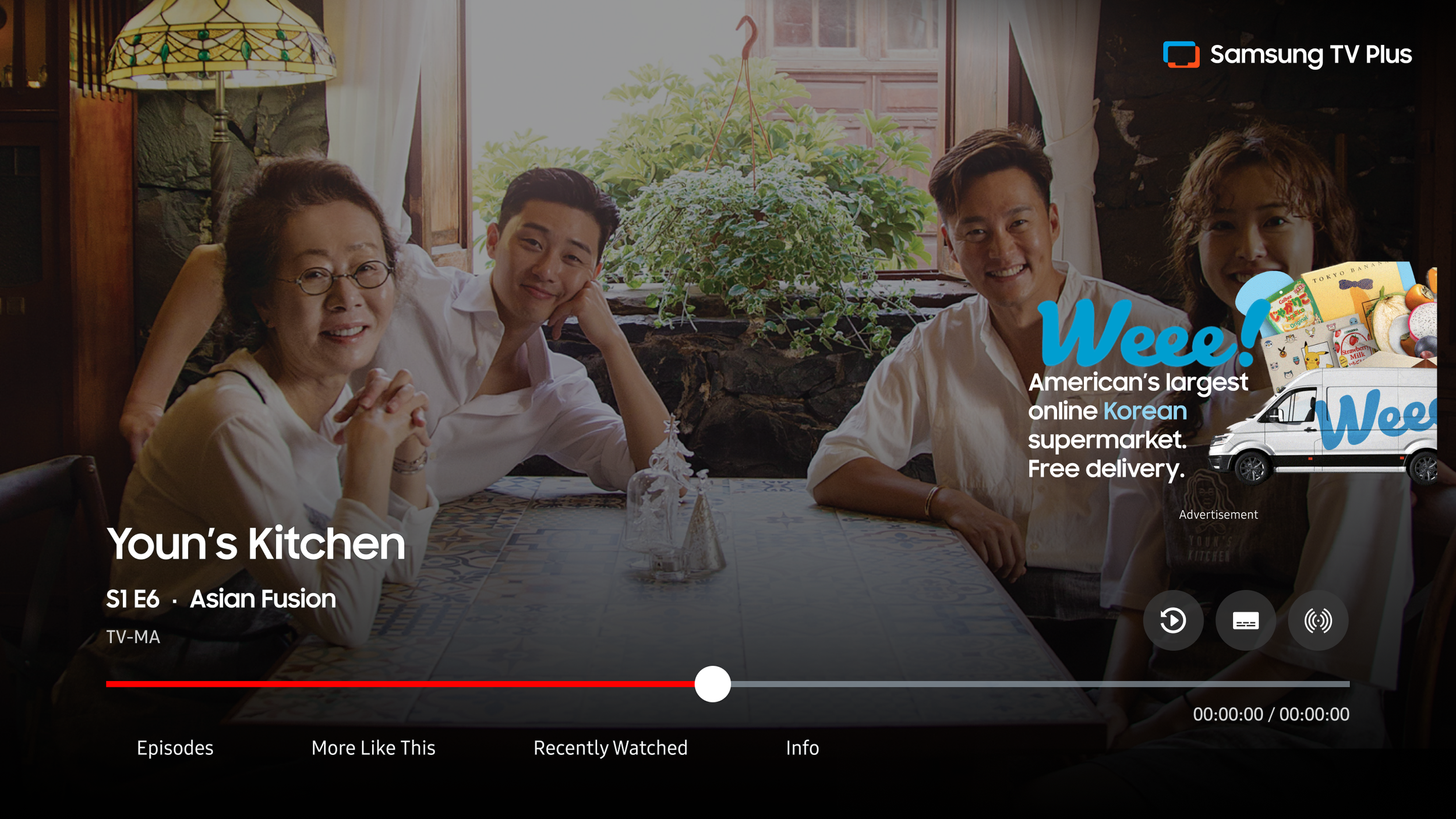
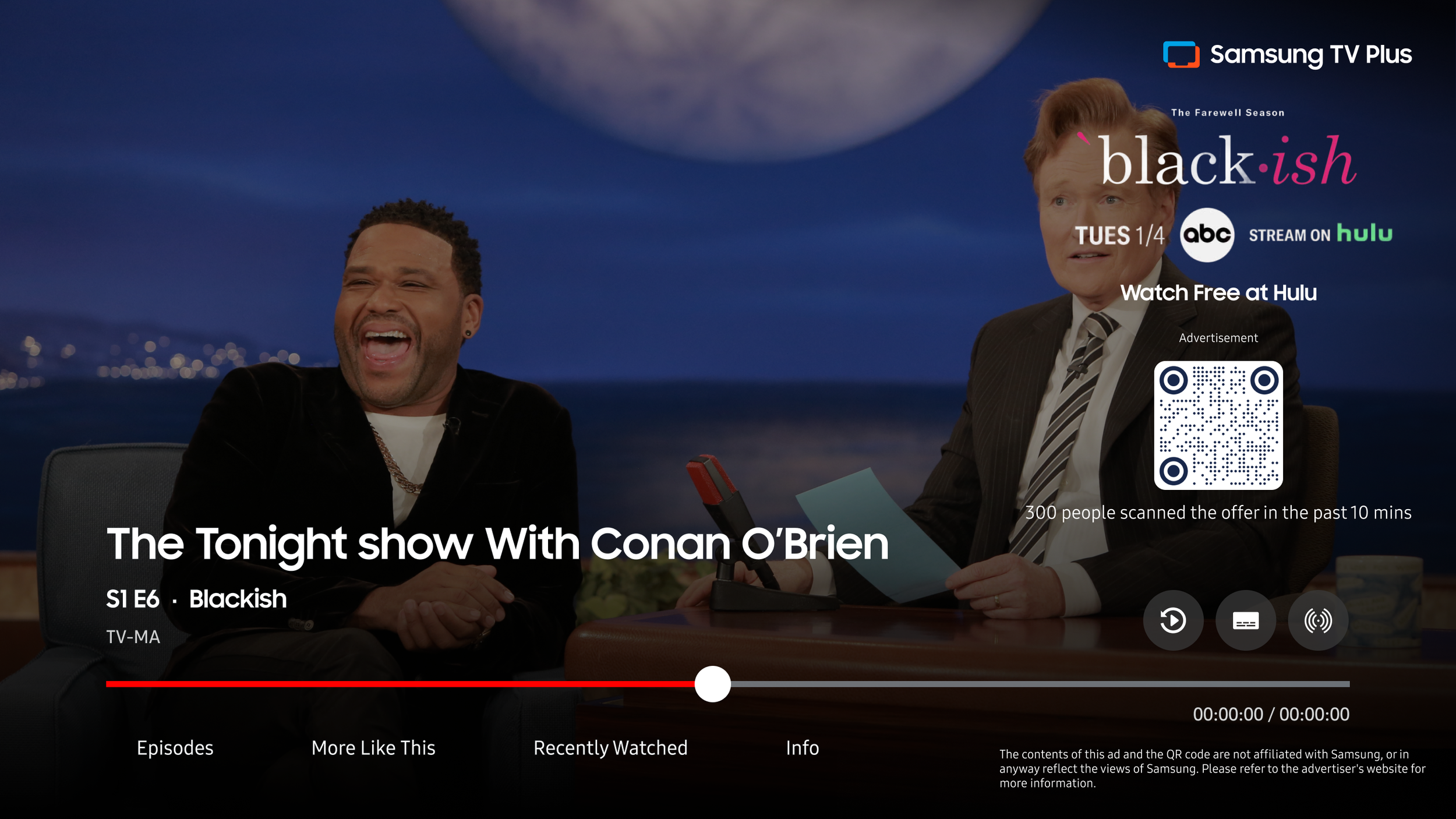
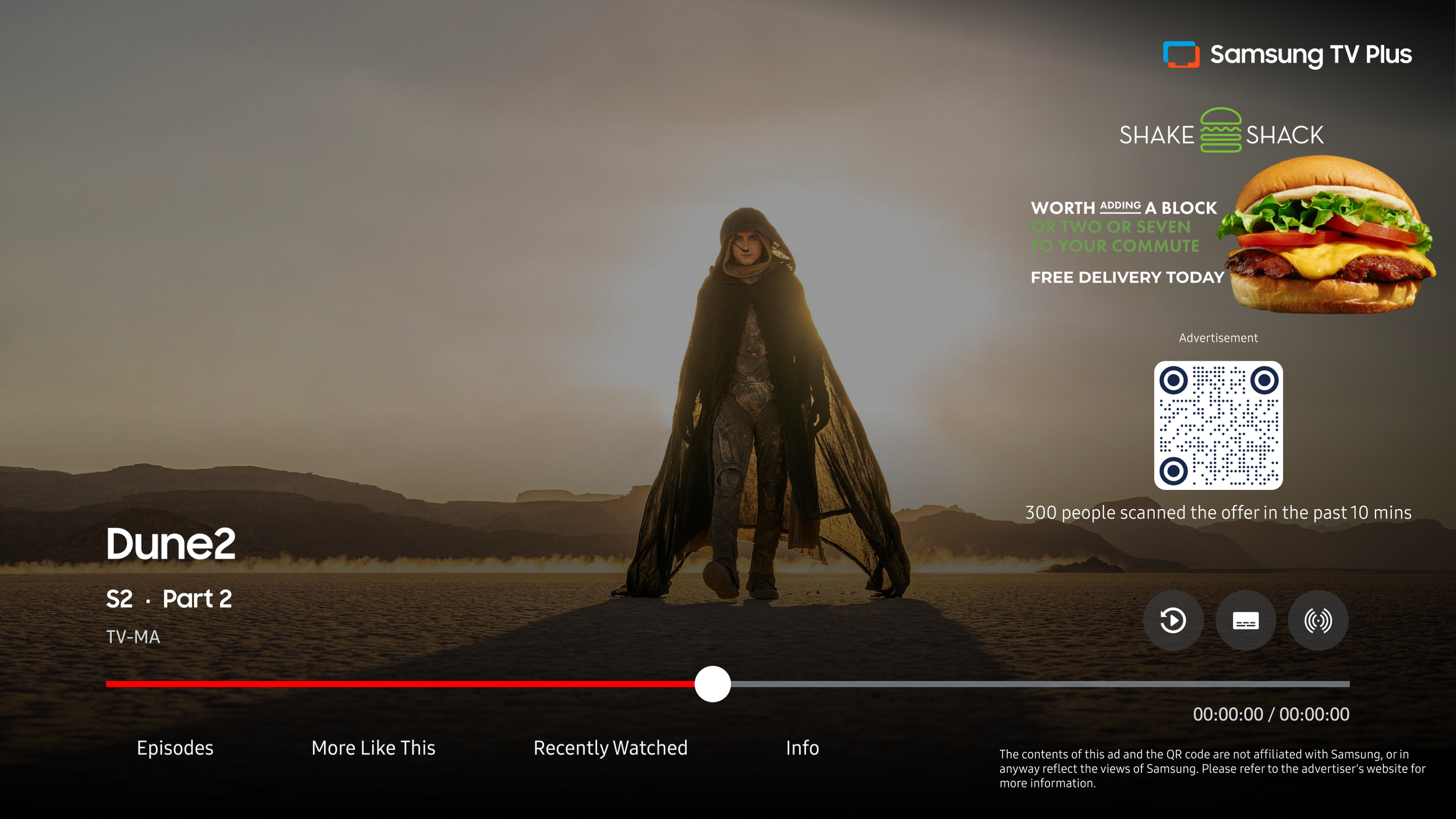
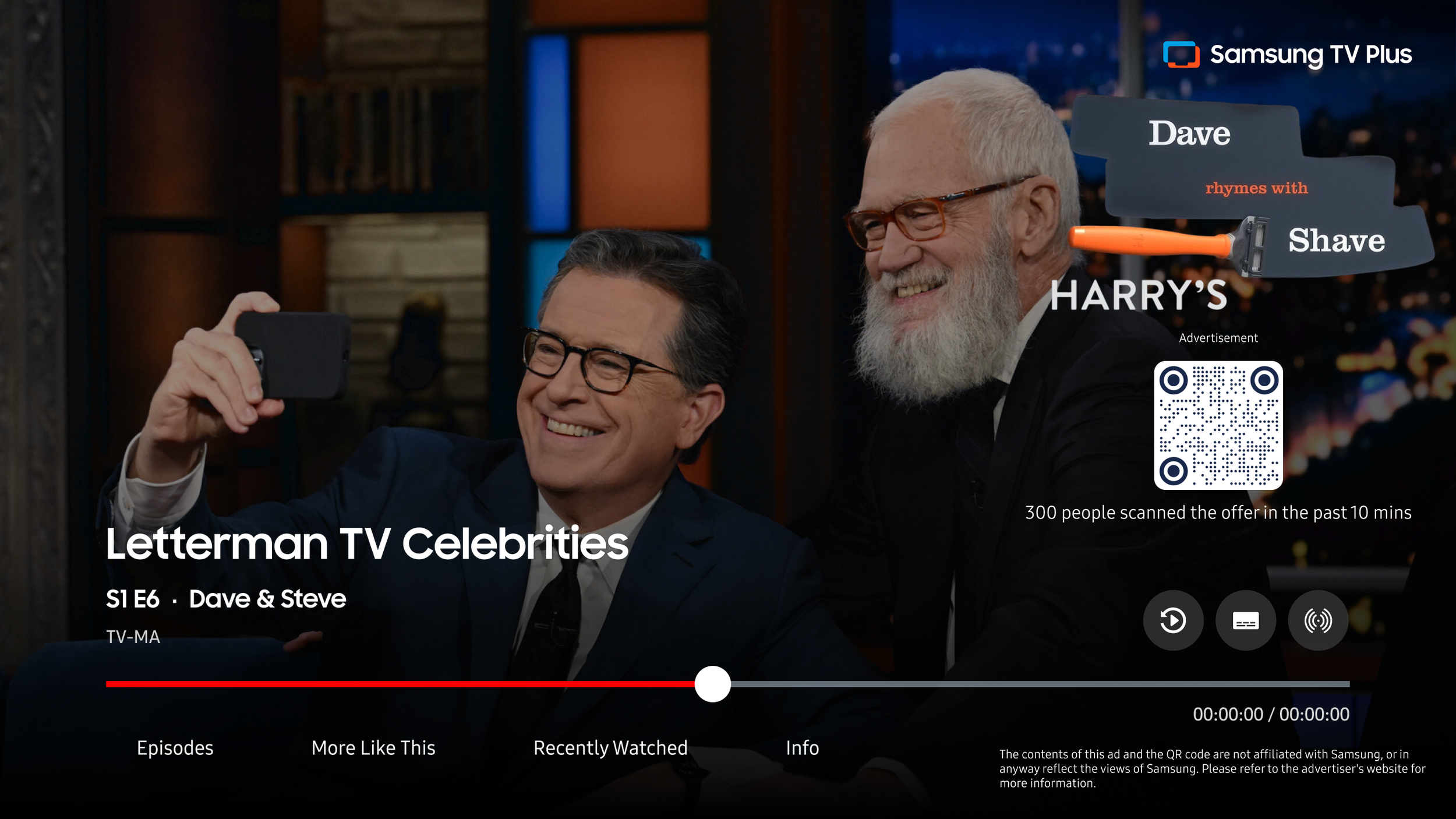
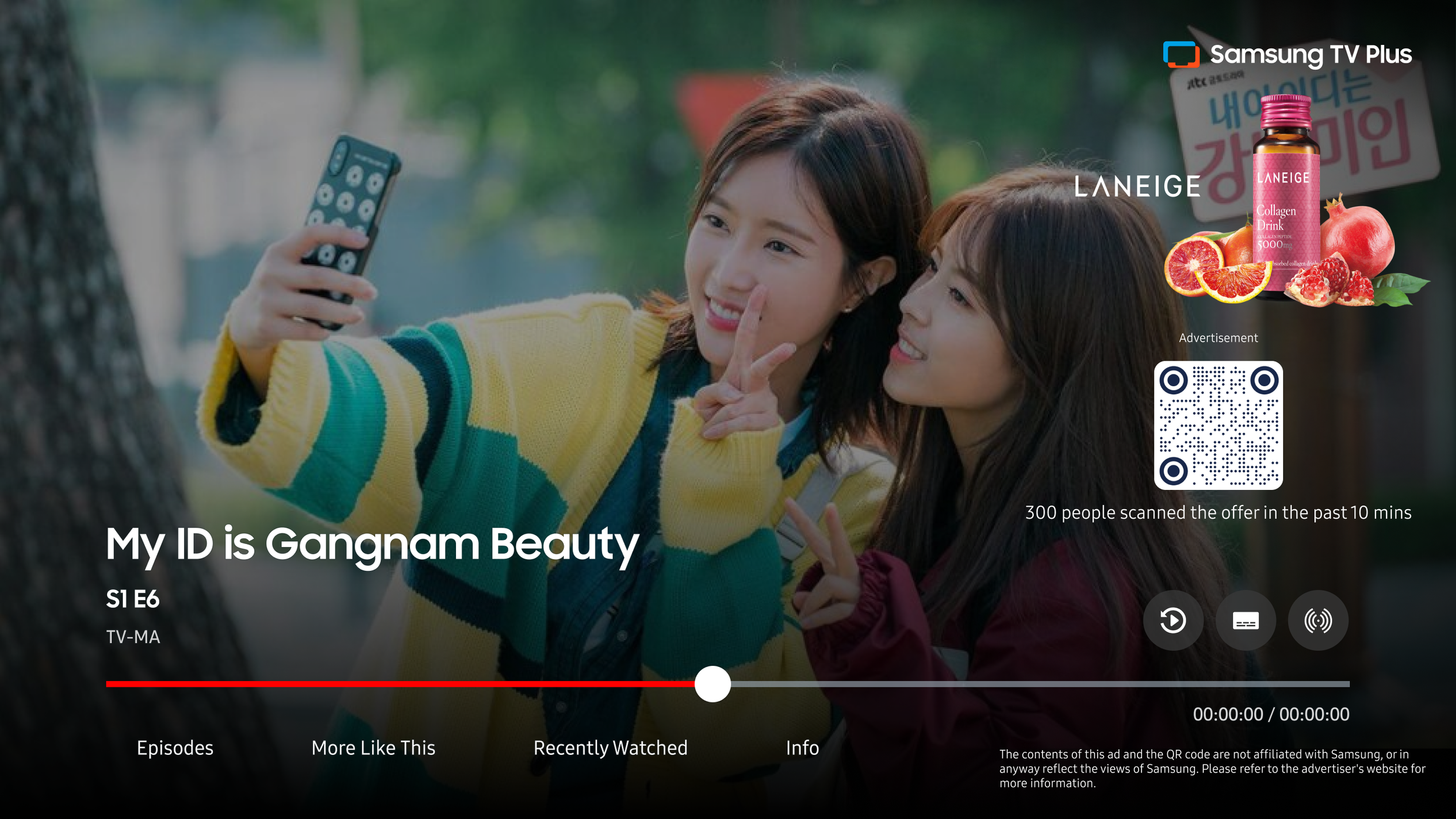
Experimentation & A/B validaton
For this test, users evaluated two paused-ad variations. One was a basic version, while the other included a QR code and social-proof messaging indicating how many people had taken the offer within a recent time window.
Variant A: Paused ad without QR Code
Variant B: Paused ad with QR Code + social proof
Increased willingness by 400%
“A/B testing showed that adding social proof to paused ads increased QR engagement—even among users who previously avoided QR scanning—by increasing perceived value and reducing uncertainty.”
Findings
-
Users previously resistant to QR Code scaning engaged when interaction was paired with a voluntary pause.
-
Social proof messageing increased perceived value.
-
No measurable decline in content satisfaction.
“Conclusion: Paused ads perform best when they are user-controlled, readable, transparent, and contextually relevant. Done right, they offer a high-recall, low-intrusion monetization opportunity”.
Business Impact
Paused Ads became a strategic complement to interactive and dynamic formats.”
Validated a new premium ad moment without content interruption
Increased advertiser interest in non-disruptive formats
Strengthened Samsung Ads’ differentiated position in CTV
Expanded inventory without increasing ad load
Strategic Impact
Paused Ads achieved:
New inventory without increasing ad frequency
Adoption across multiple advertiser verticals
Contribution toward ~$5M projected revenue opportunity
Establishment of a reusable interaction layer
More importantly:
It shifted the monetization model from interruption-based to behavior-based engagement.
System-Level Contribution
Paused Ads became:
A template for future interactive overlays
A structured signal source for AI-powered contextual ranking
A scaleable format across markets
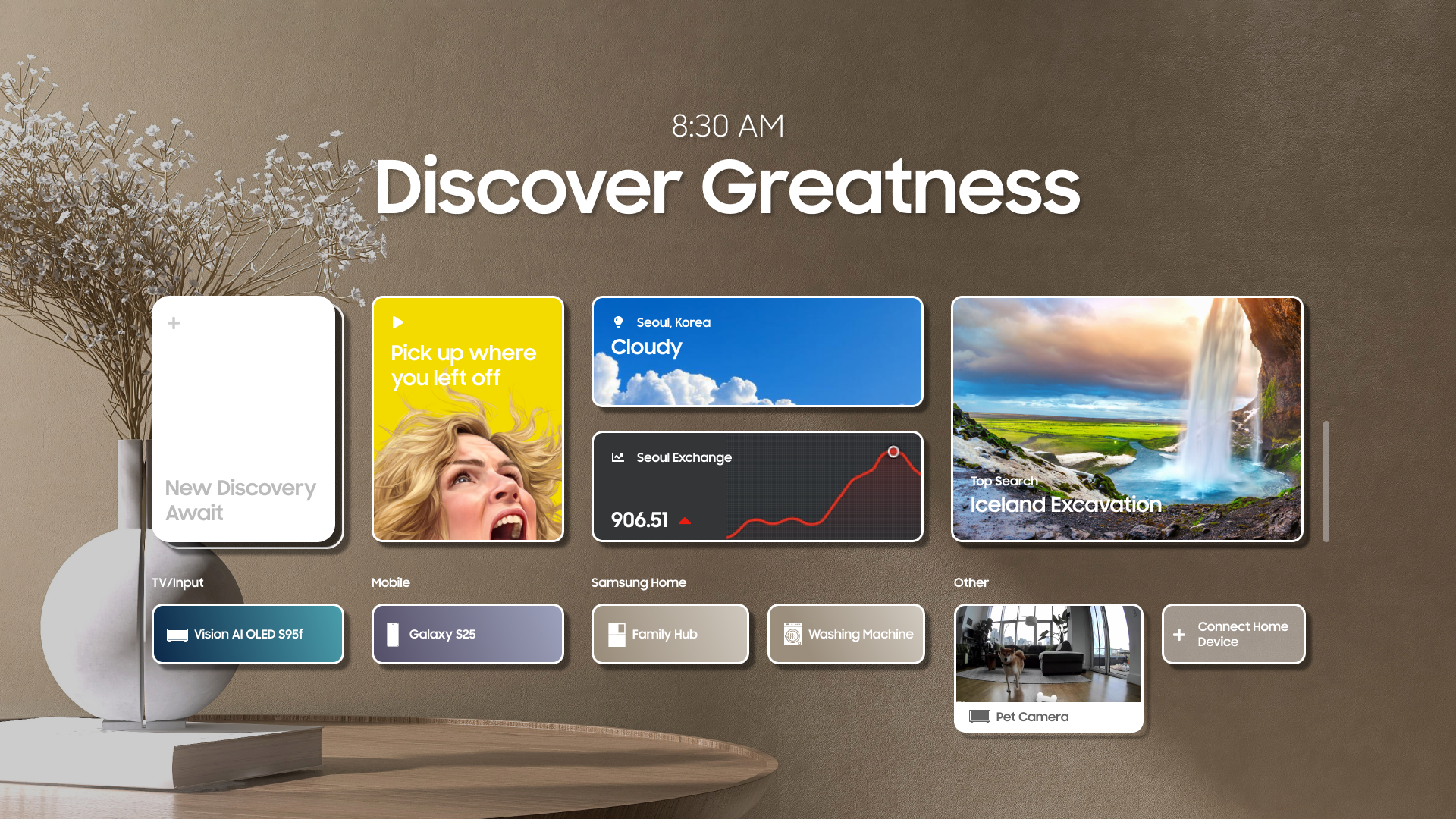
Vision AI (VAC): Intent-Driven Discovery and Advertising on TV
Vision AI reimagines the TV as an intelligent, centralized interface—using user intent to connect content discovery, device control, and contextual advertising into a single, cohesive experience.
Project Overview
Background
1
The Vision AI project was designed to help users discover relevant content while delivering ads aligned with their search intent.
It also presented a business opportunity to extend personalized ad experiences based on user prompts, positioning the TV as a centralized hub that connects and controls experiences across devices in the home.
My Role
2
As interactive ad formats matured (Carousel > Dynamic QR Code > Paused Ads), I saw an emerging gap: We had engagement surfaces – but limited intelligence driving what user actually saw.
Defined AI application use case
Structured research problem framing
Synthesized user insights with AI capabilities
Participated in Microsoft AI learning community
Prototyped AI-assisted workflow simulations
Explored ethical and privacy guardrails
Problem Statement
3
User Problem
Users must manually search or scan to find relevant products.
Discovery on TV is friction-heavy.
Recommendations lack contextual awareness.
Business Problem
Advertisers want precision targeting.
Engagement varies widely across categories.
Monetization lacks adaptive intelligence.
How can AI reduce interaction friction while increasing contextual relevance – without violating user trust?
Opportunity
4
Vision AI addresses a growing gap between fragmented content discovery, disconnected devices, and generic advertising experiences in the living room. Today, users struggle to find relevant content quickly and manage multiple devices across ecosystems, while advertisers lack contextual, intent-driven moments to engage audiences. Vision AI solves this by centralizing discovery, control, and monetization on TV—using user intent and real-time context to deliver relevant content, coordinated device experiences, and high-value, non-disruptive ads. This creates a differentiated platform that improves user satisfaction, increases engagement, and unlocks new premium advertising opportunities.
Hypothesis
If we use vision-based content analysis and behavioral data:
We can surface contextually aligned products.
Increase voluntary engagement.
Improve advertiser ROI.
Reduce irrelevant exposure without increasing UI complexity.
Solution Overview
VAC System Concept
Vision AI analyzes:
On-screen content context
Category alignment
Viewer behavior paterns
Outputs:
Dynamic product ranking
Contextual overlays
Smarter QR-triggered experiences
Design principles:
Invisible intelligence
No added interaction burden
Clear user control
AI-Assisted Insight Synthesis
I used AI tools to accelerate qualitative insight clustering and pattern detection across user research datasets.
Applications:
Thematic grouping
Behavioral signal mapping
Hypothesis generation
Rapid scenario modeling
Designing at the Platform Level with Vision AI
For the Vision AI project, I approached the product from a platform perspective—aligning business goals with a cohesive end-to-end experience. I designed an AI dashboard that unifies content discovery, advertising, and device control, enabling users to manage all household devices seamlessly from the TV, creating a centralized, living-room–first experience.
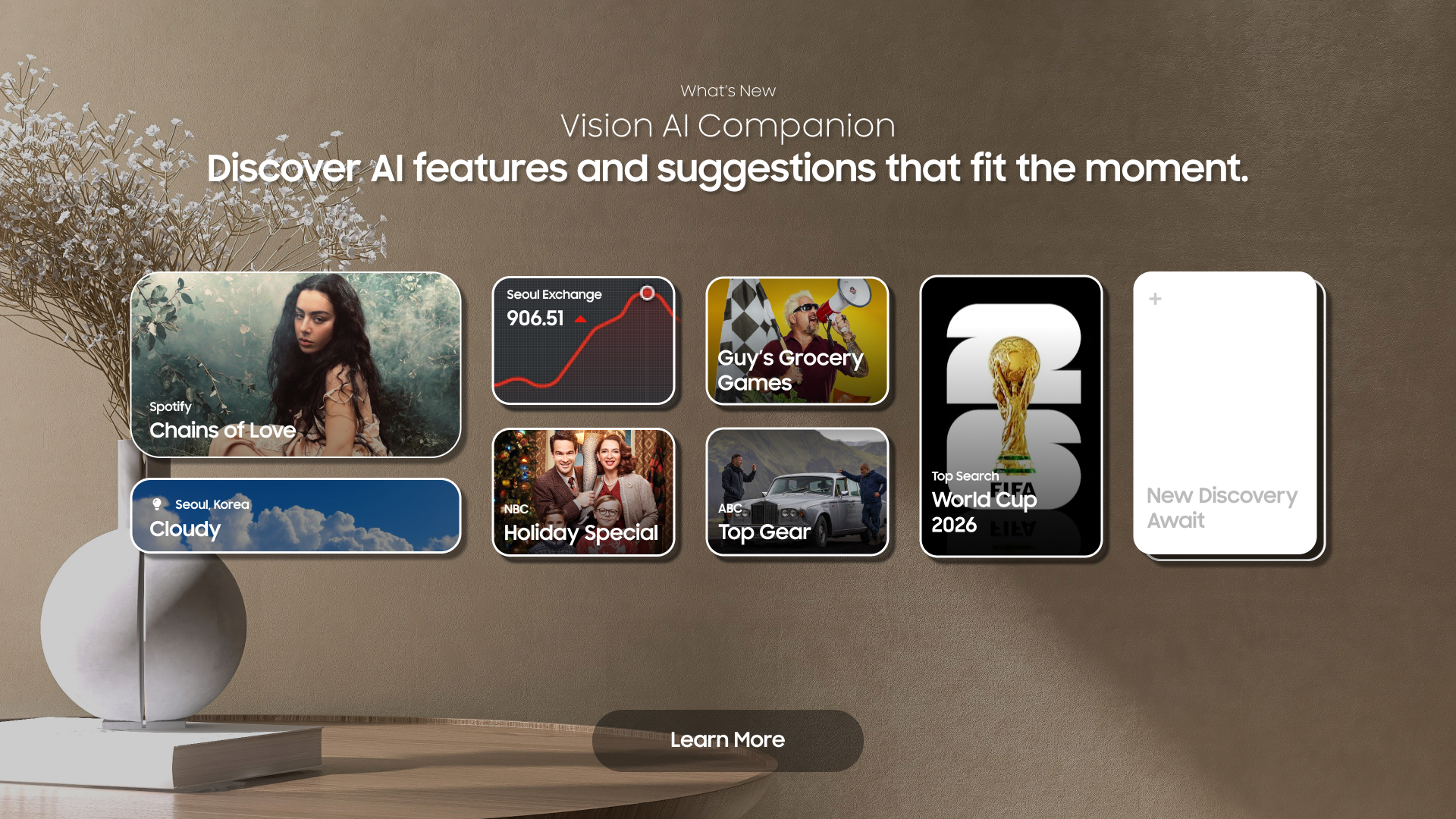
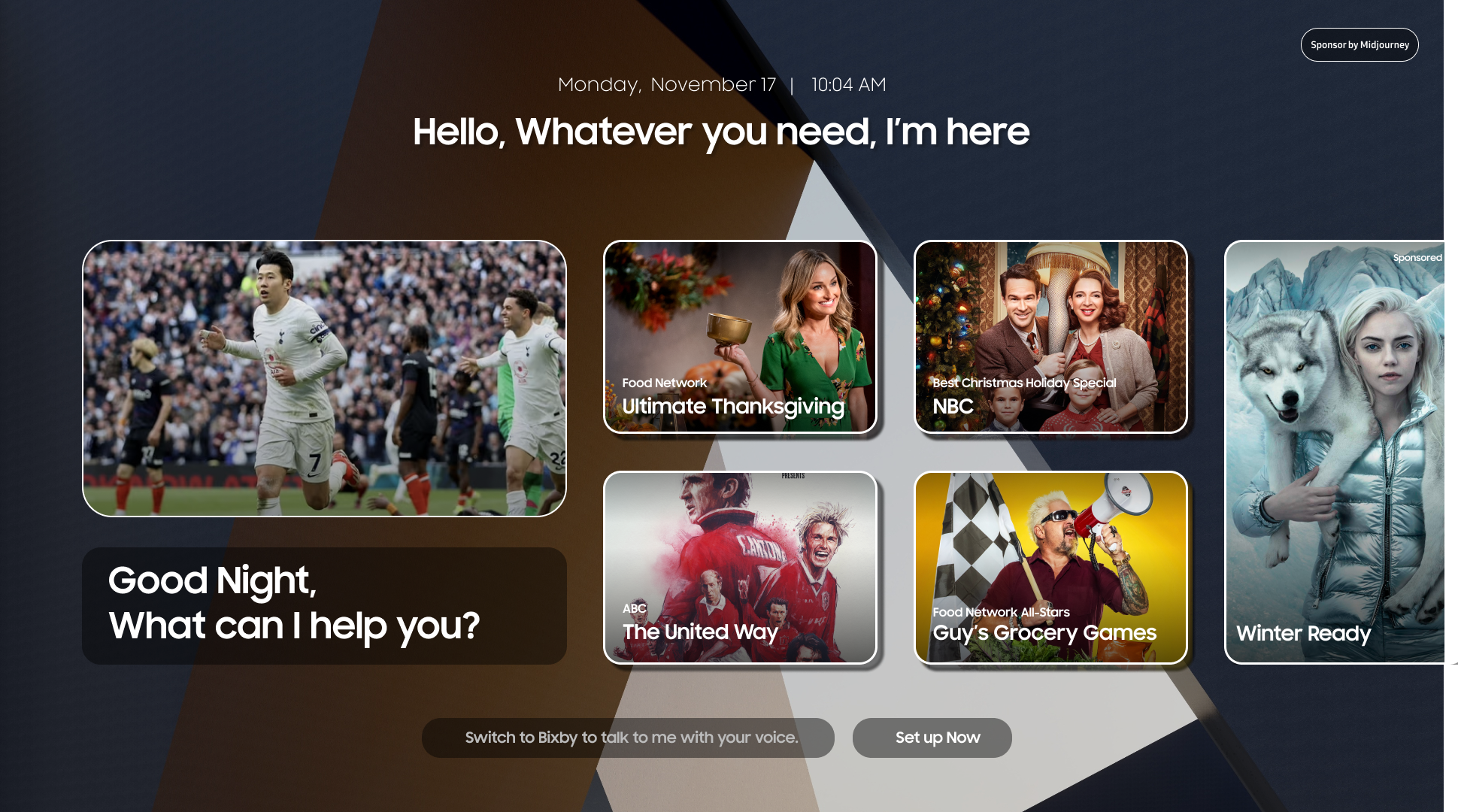
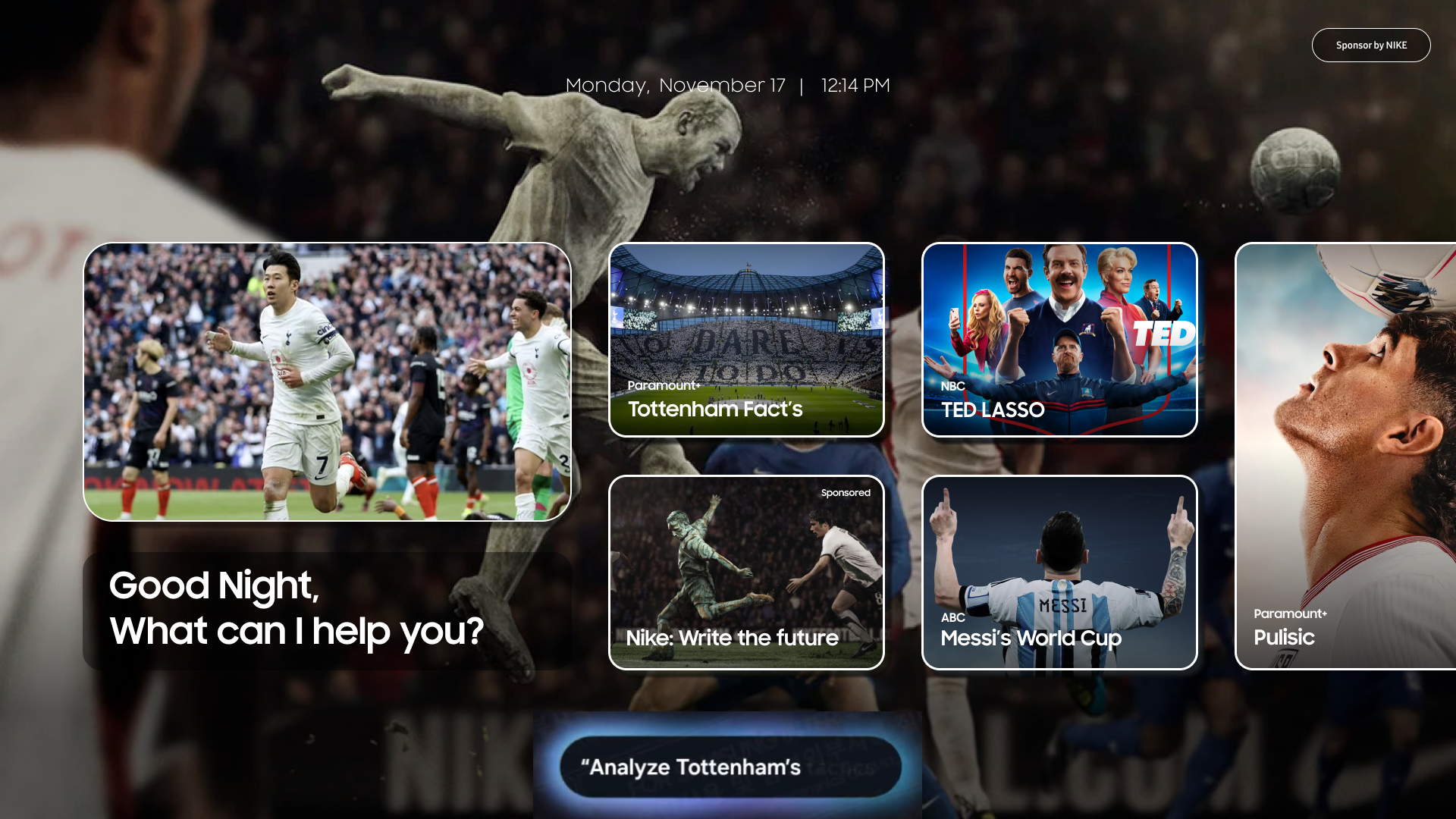
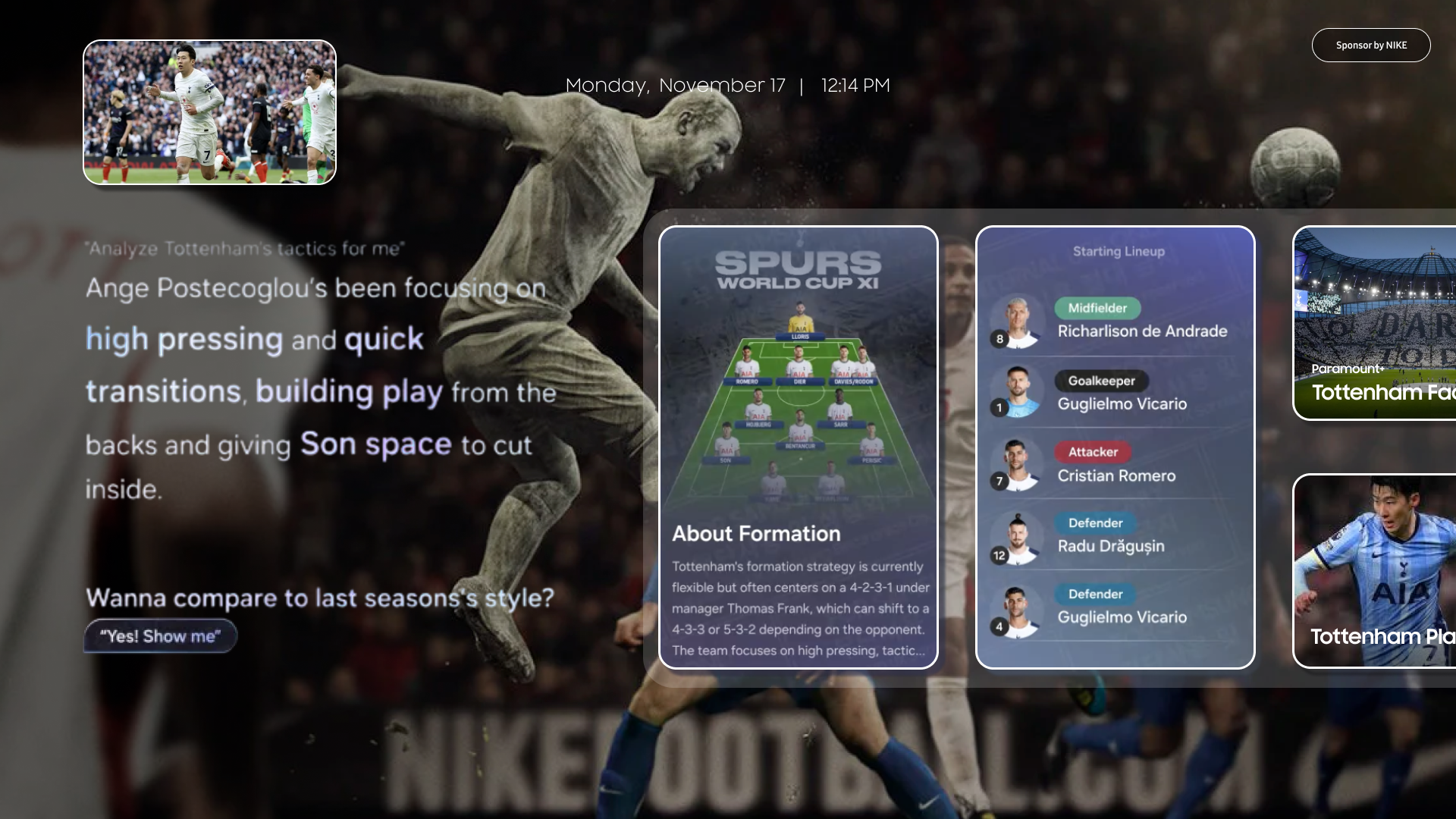
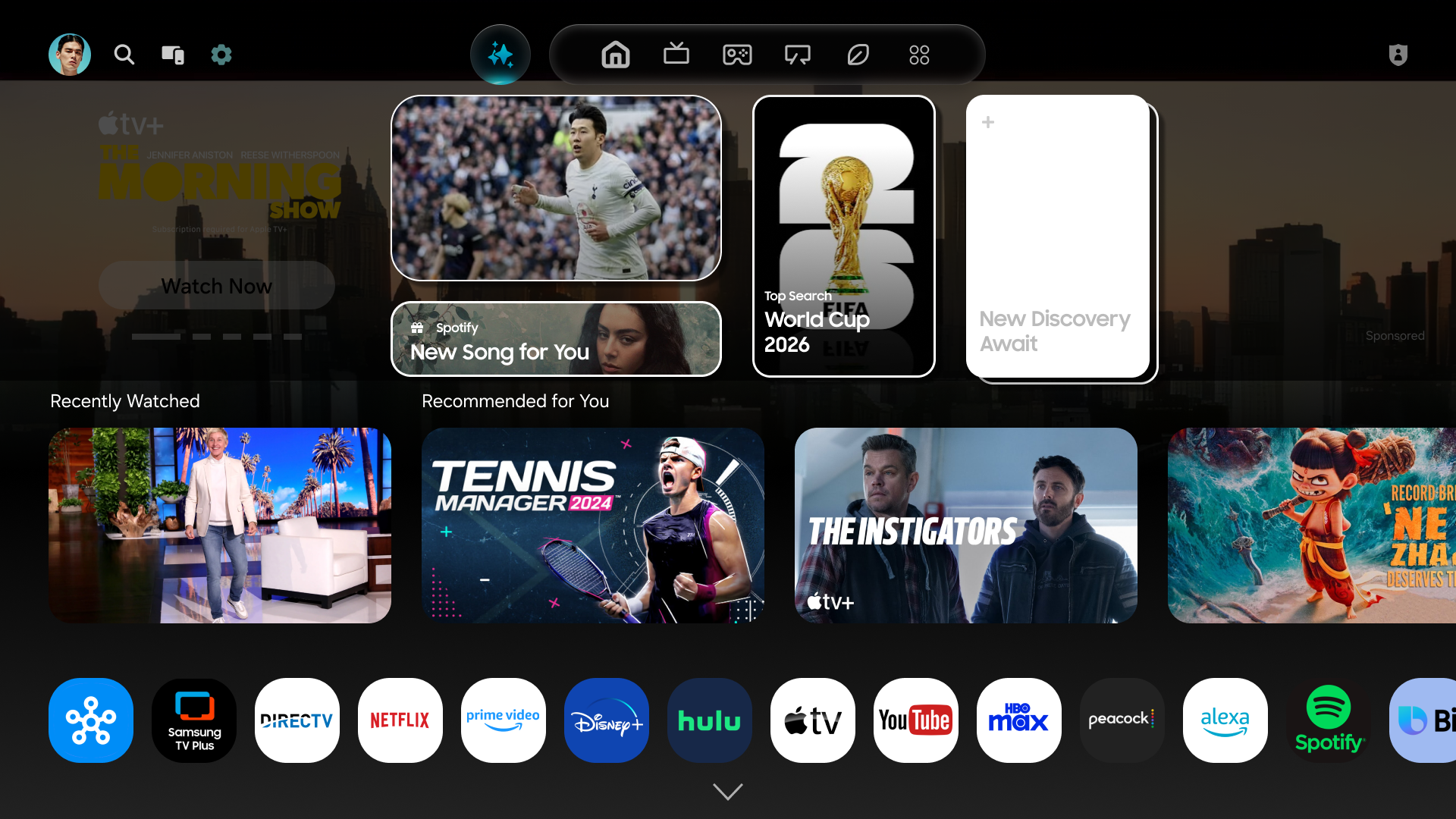
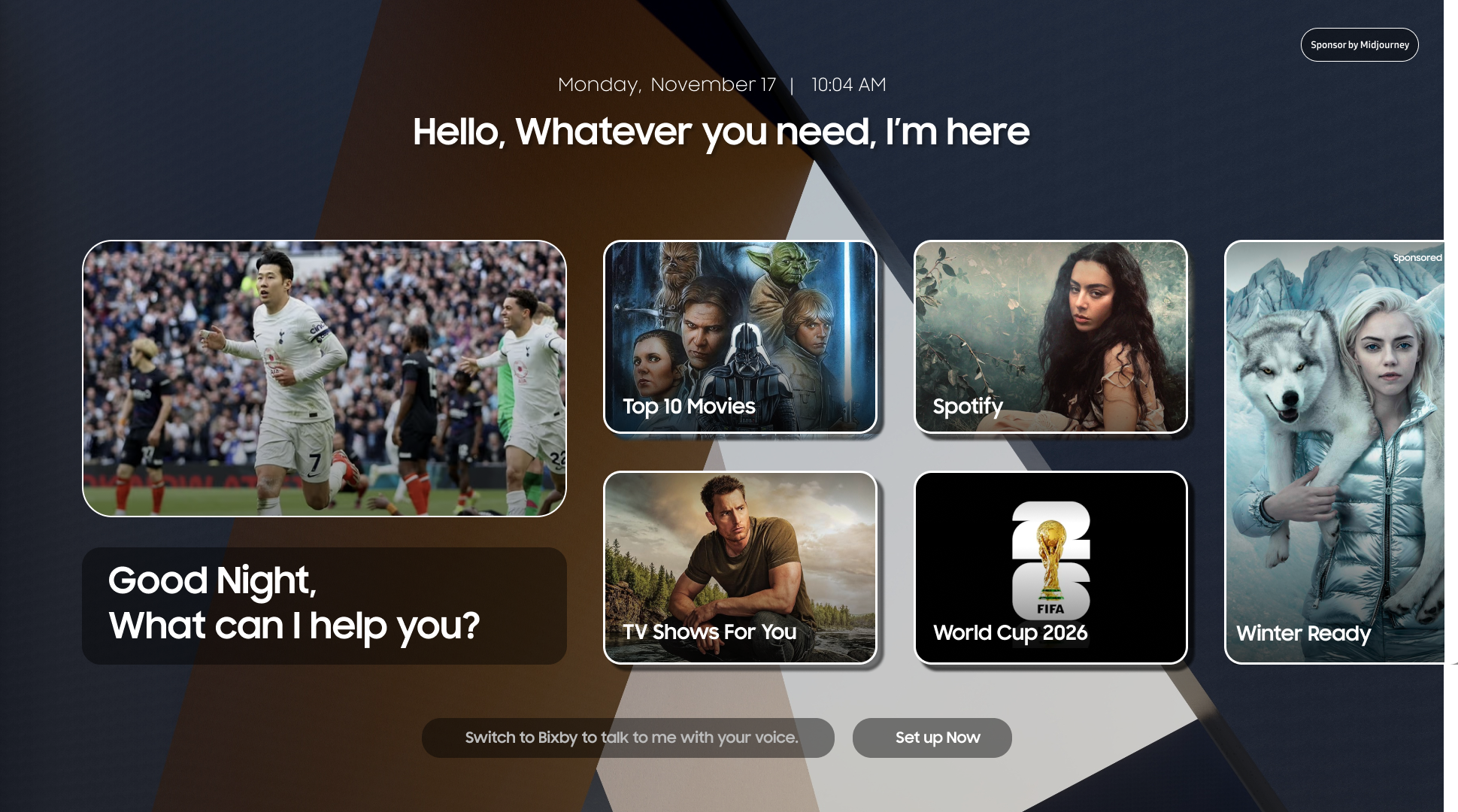
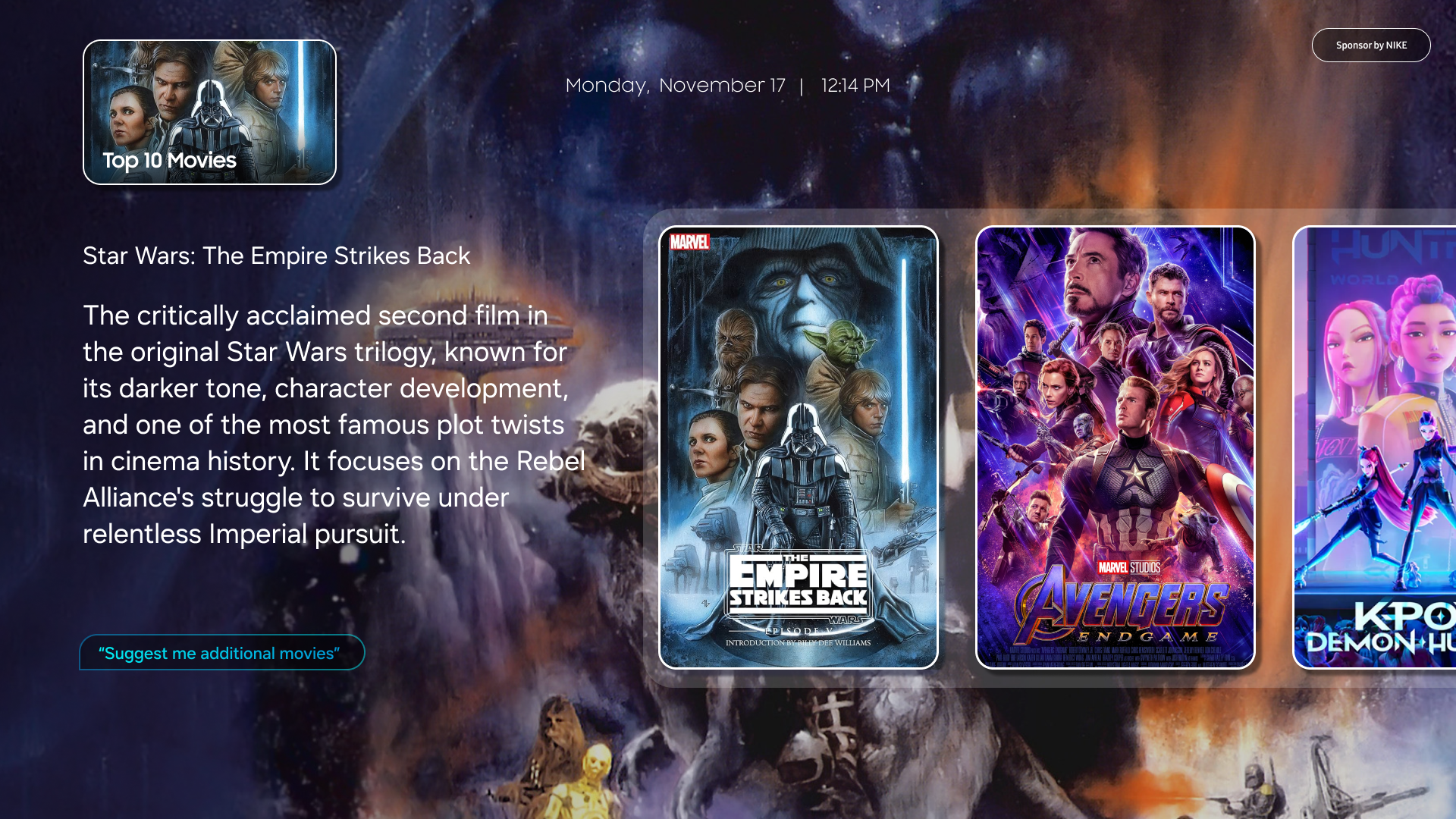
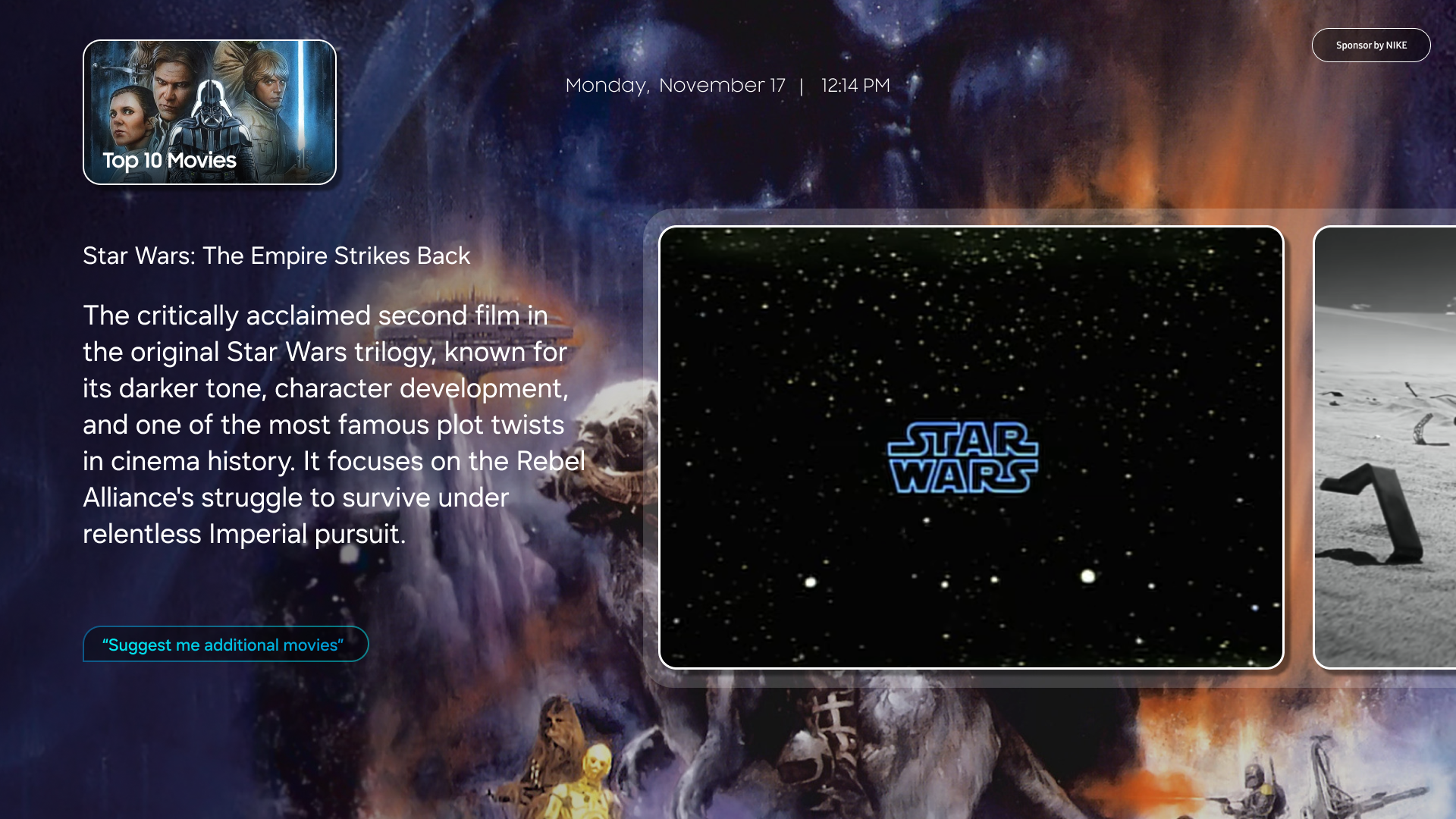
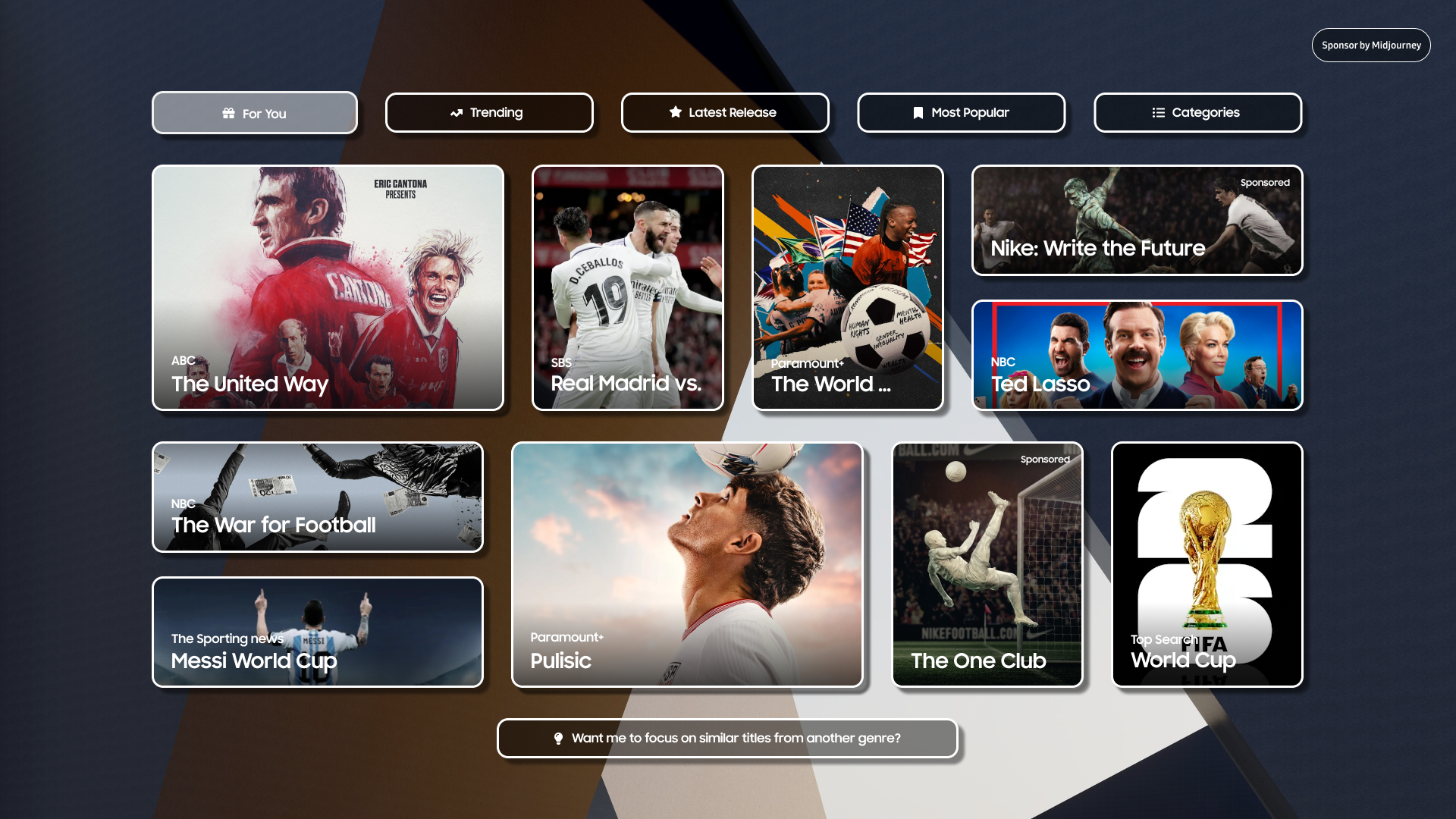
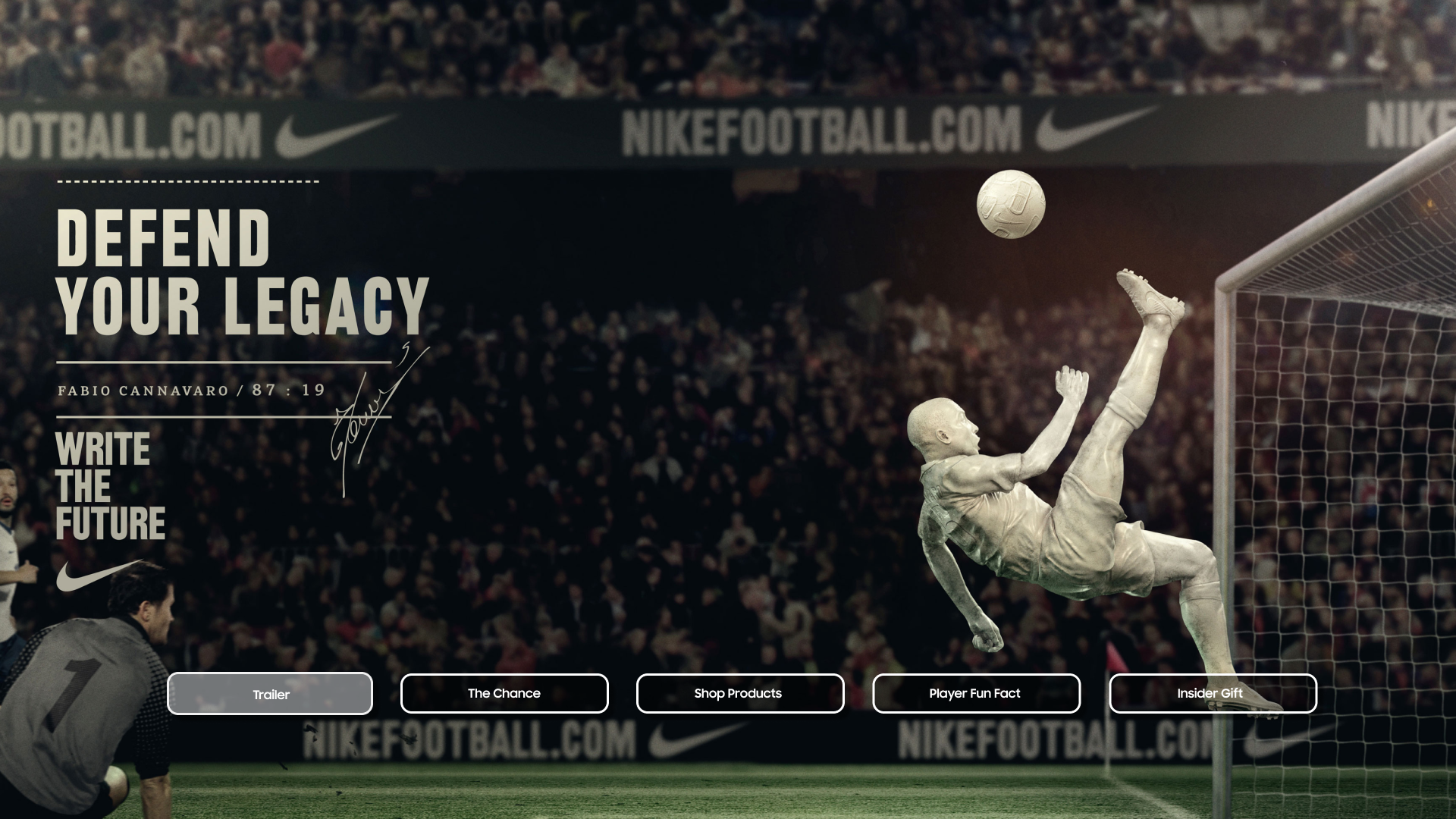
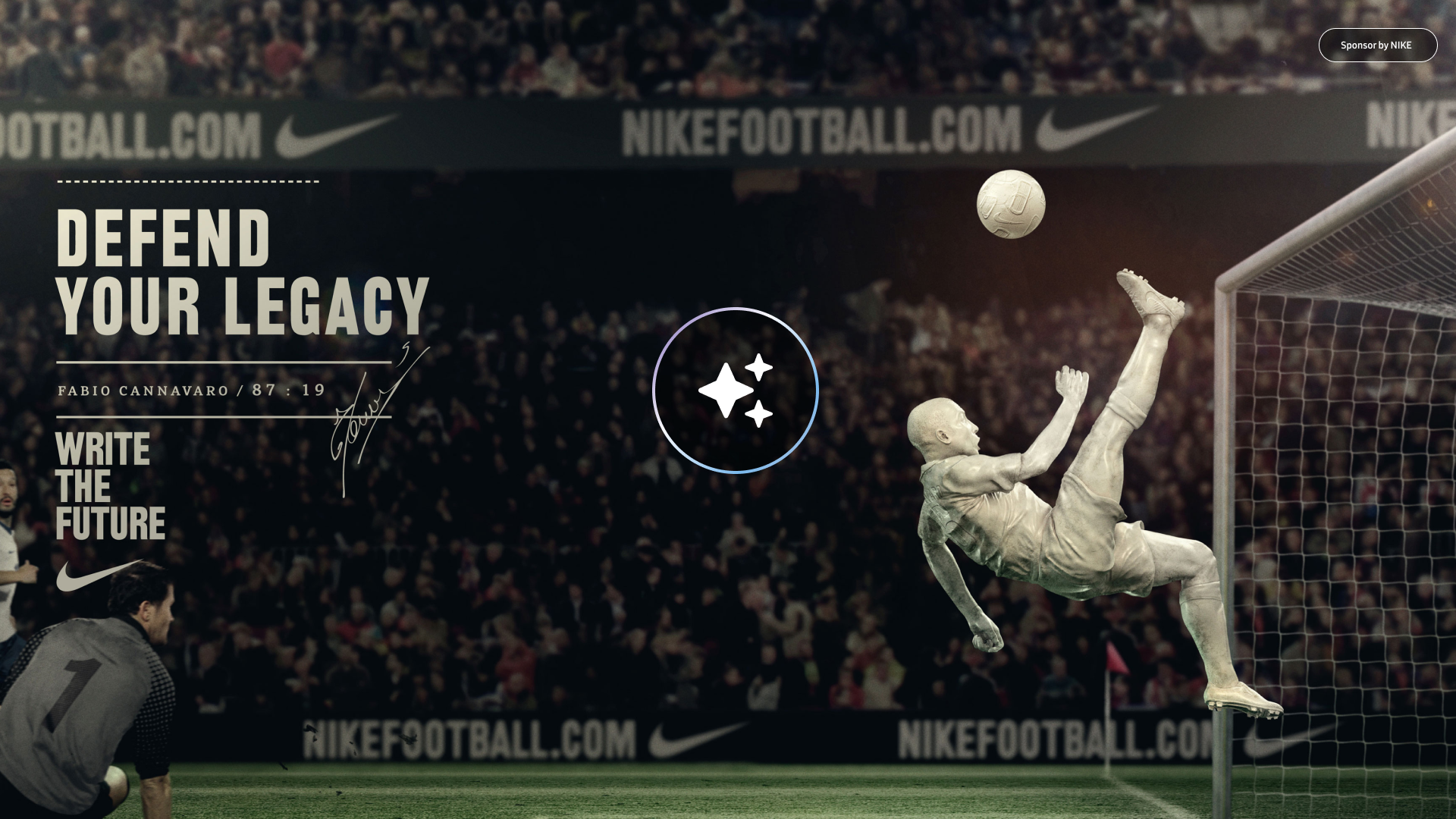
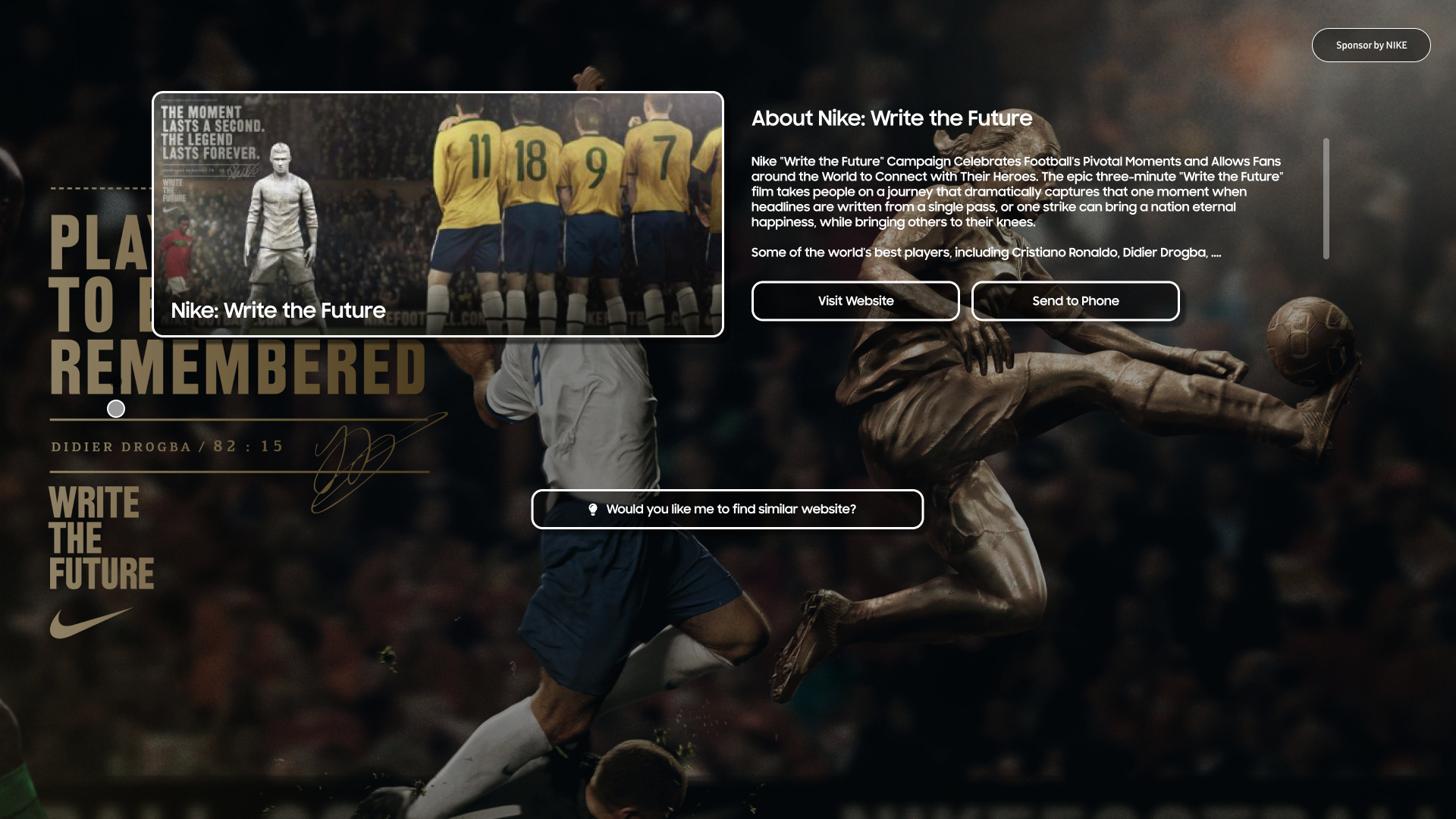
Vision AI Opportunities User Flow
-
![]()
1. Revisit the Original Design Framework to Enhance the Overall Experience
-
![]()
2. Unlocking Ad Placement Opportunities During Prompt Load Time
-
![]()
3. Unlock Opportunities to Deliver Contextually Relevant Content
-
![]()
4. Surface Relevant Ads While Delivering Prompt Results
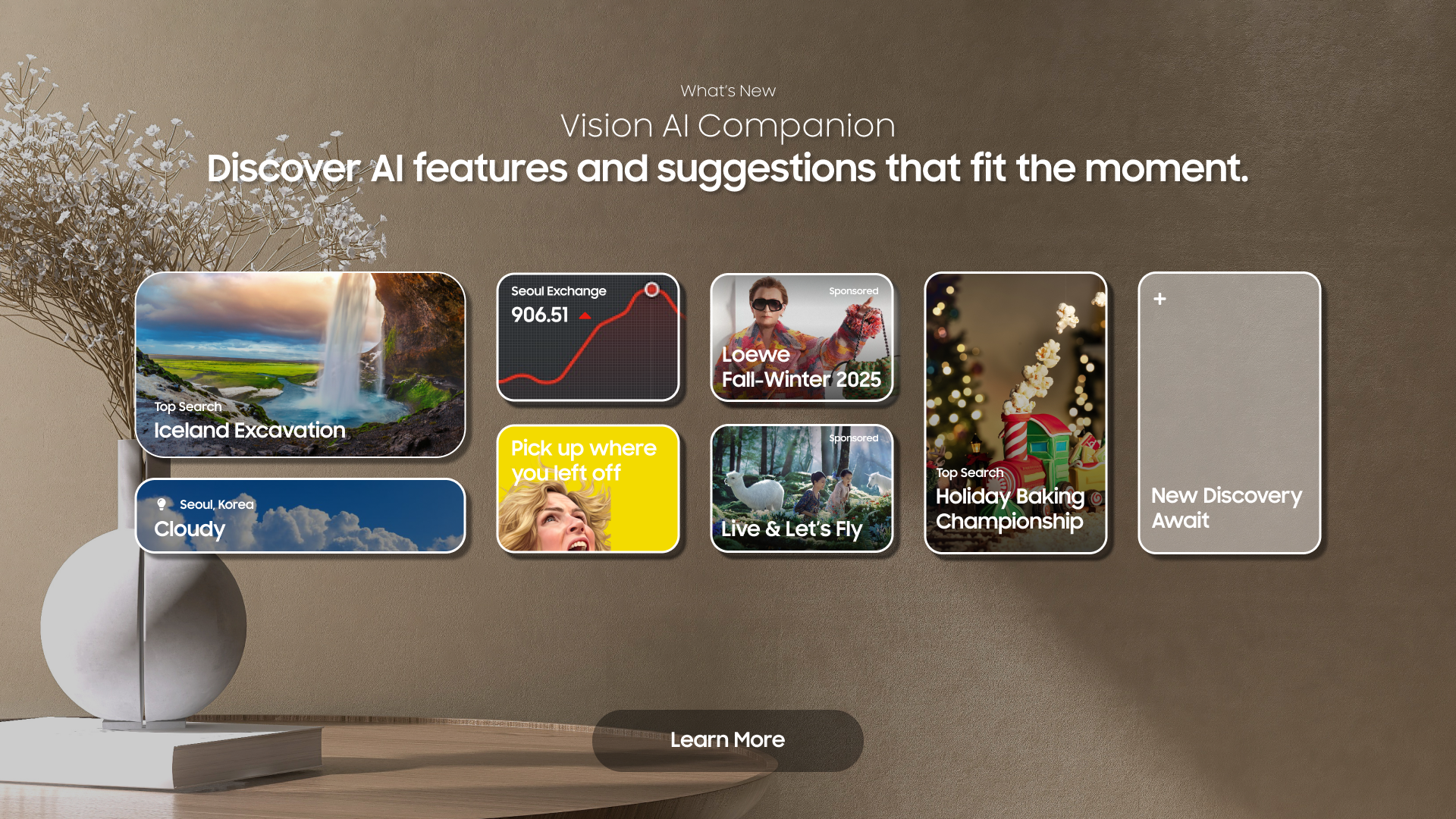
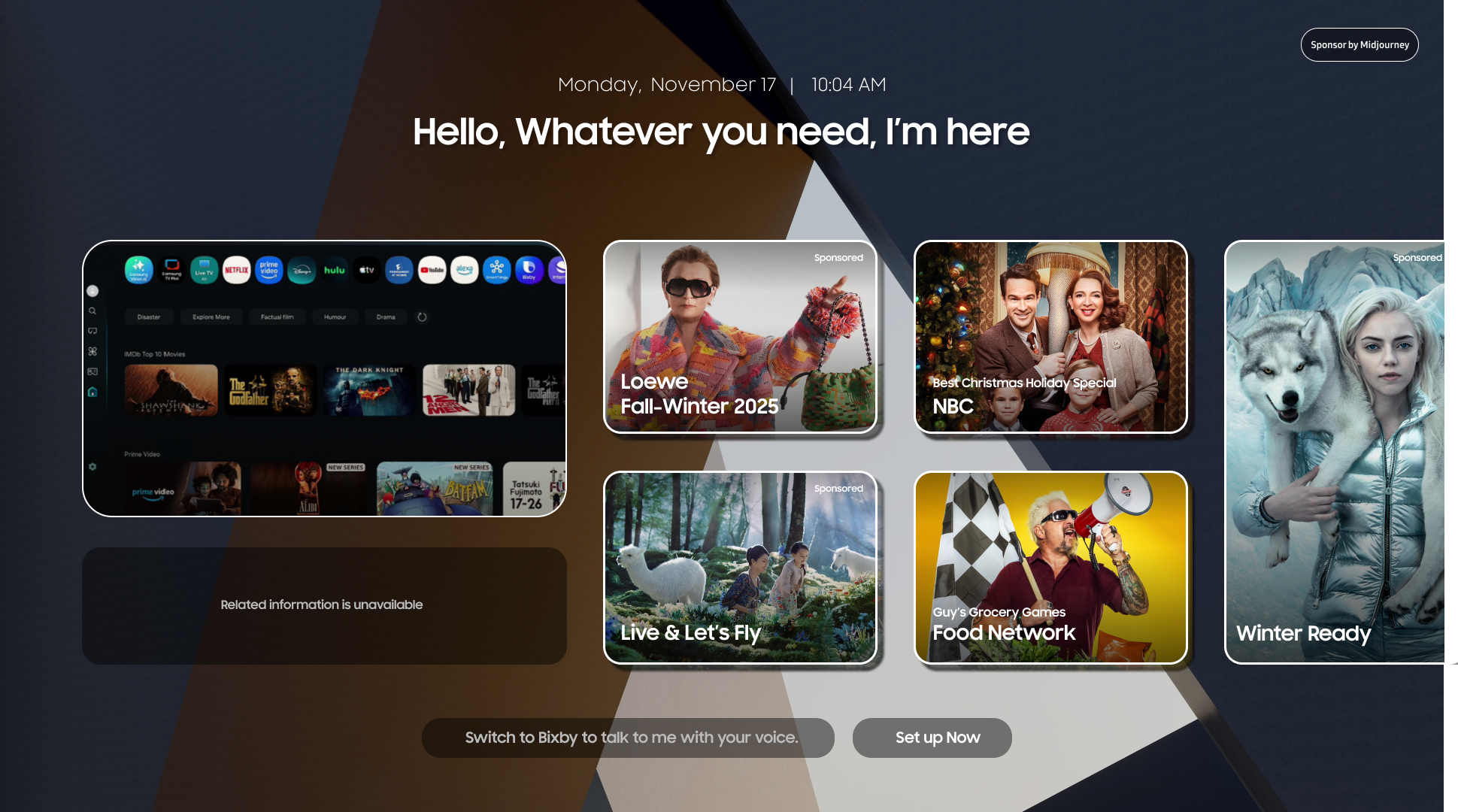
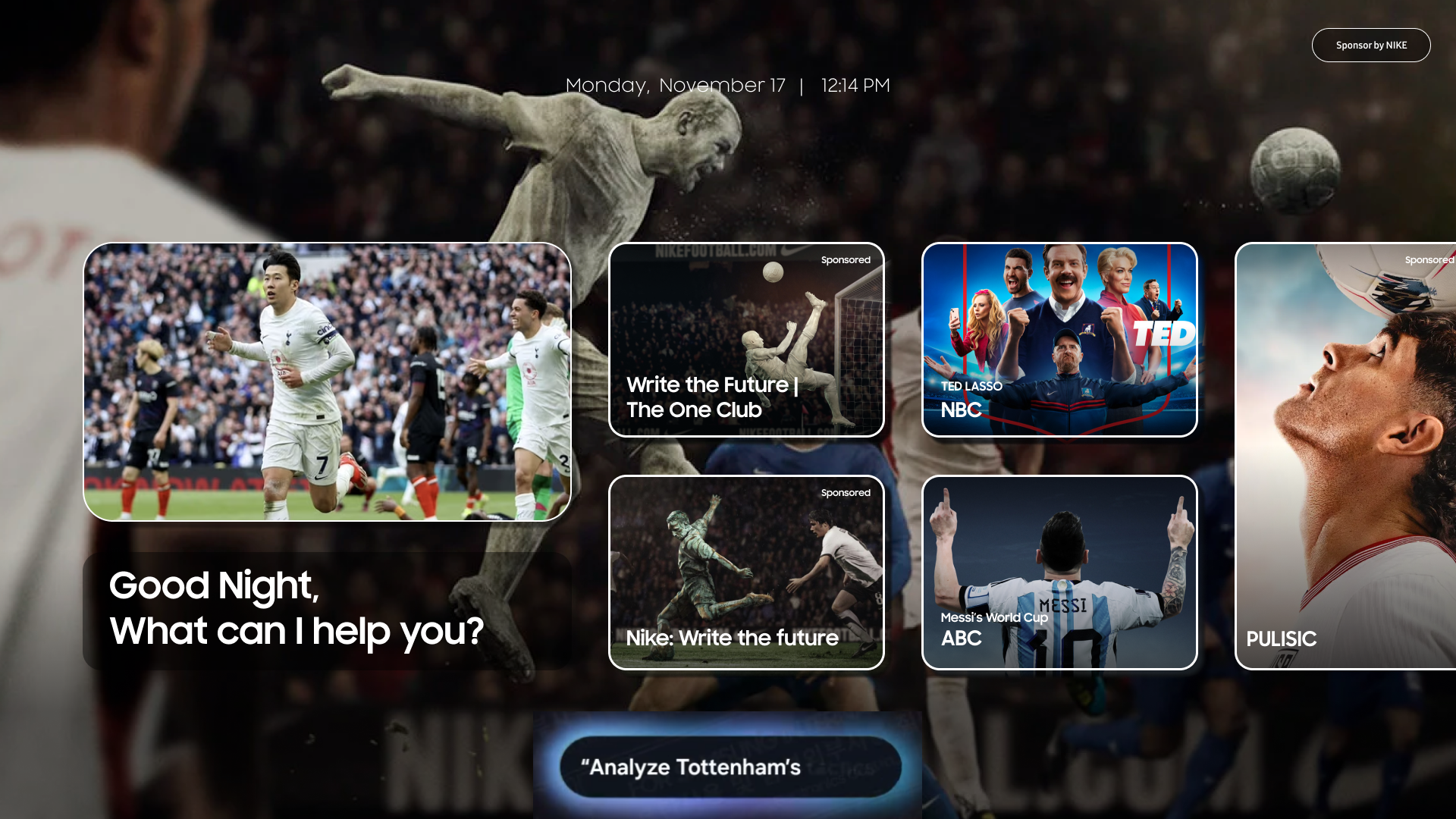
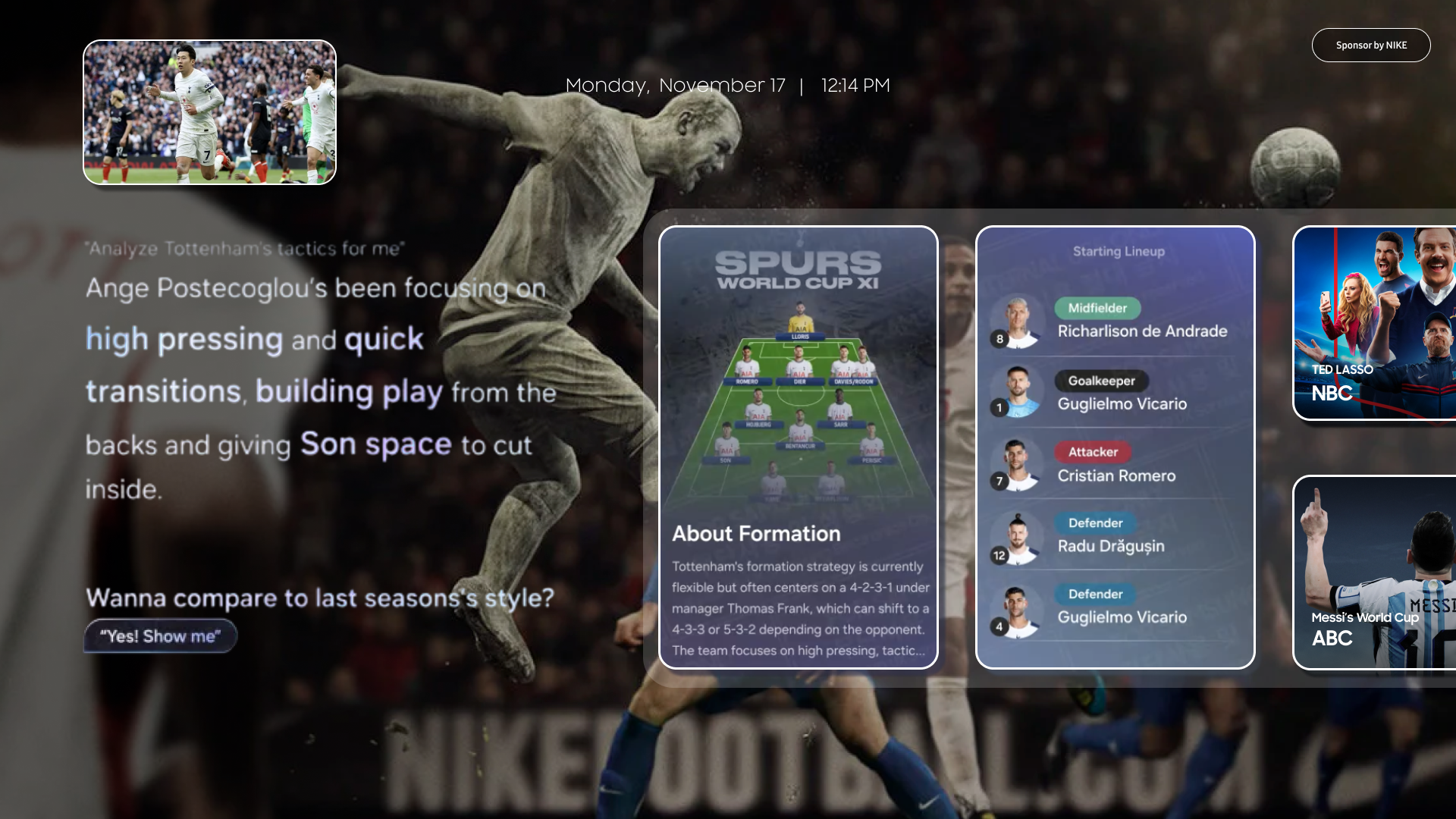
Intent-First AI Experience (VAC)
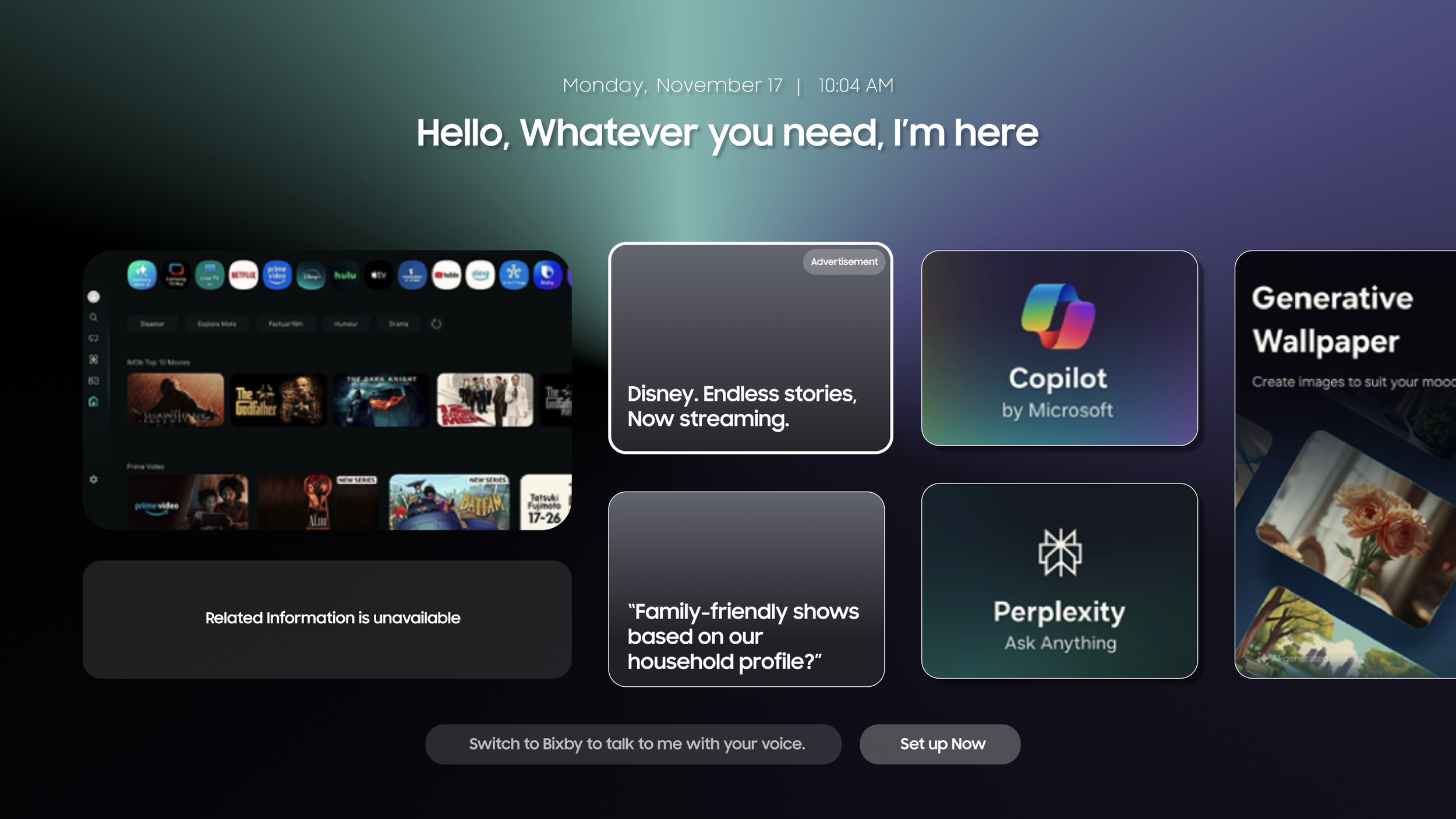
AI entry via remote for low-friction access
Pre-populated prompts based on household behavior
Results combine:
Relevant content
Sponsored placements (clearly labeled)
Optional actions (save, send to phone, continue watching)
TV acts as the centralized dashboard for discovery and control
Ads are contextual, optional, and intent-aligned.
Pharse 1: User Flow
-
![]()
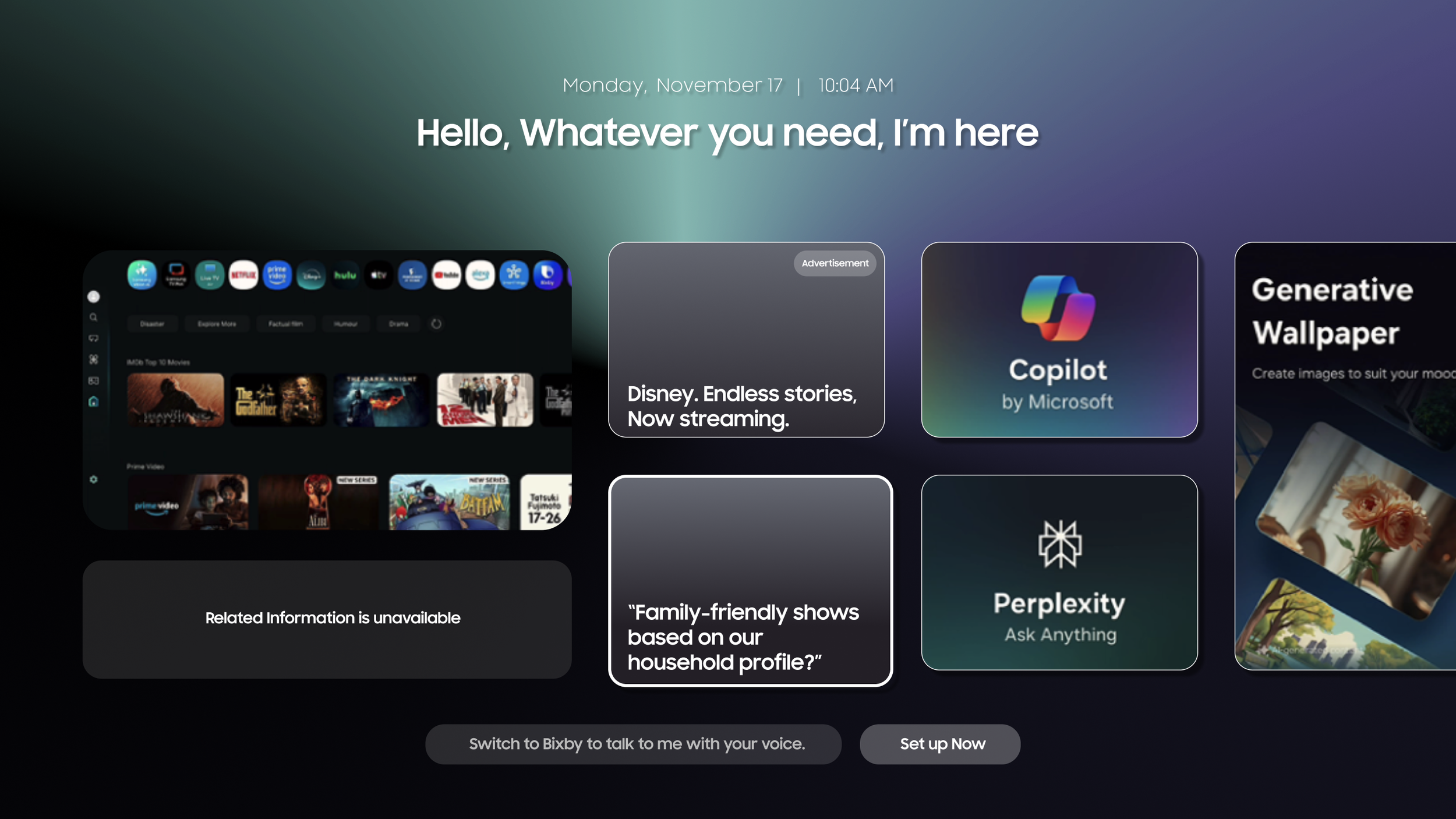
1. Invoke AI Assistant : The user presses the AI Assistant button on the remote. The system presents two recommended options based on the user’s past viewing behavior and preferences.
-
![]()
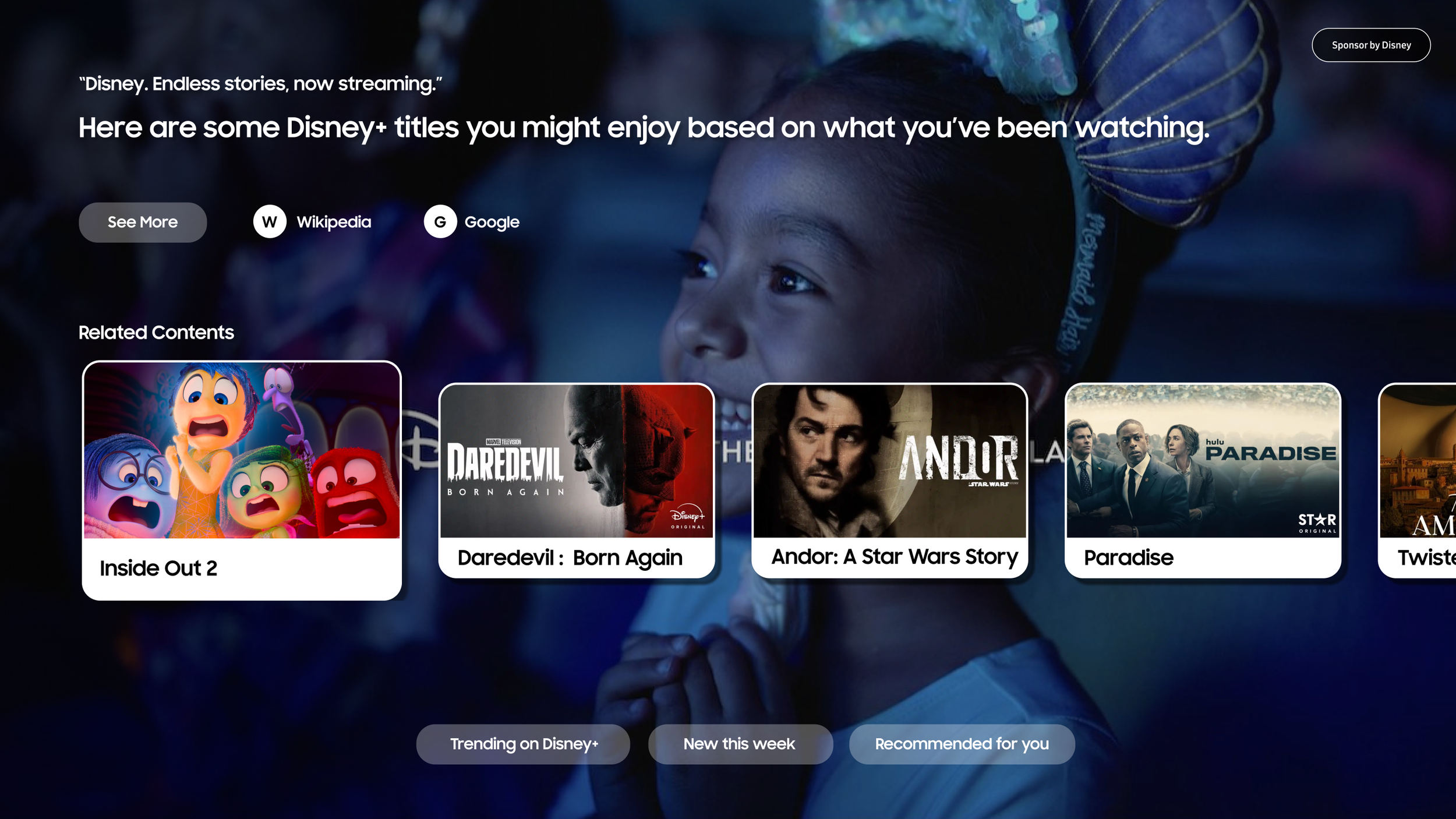
2. Select Sponsored Recommendation: The user selects an advertiser tile featuring a recommended Disney show.
-
![]()
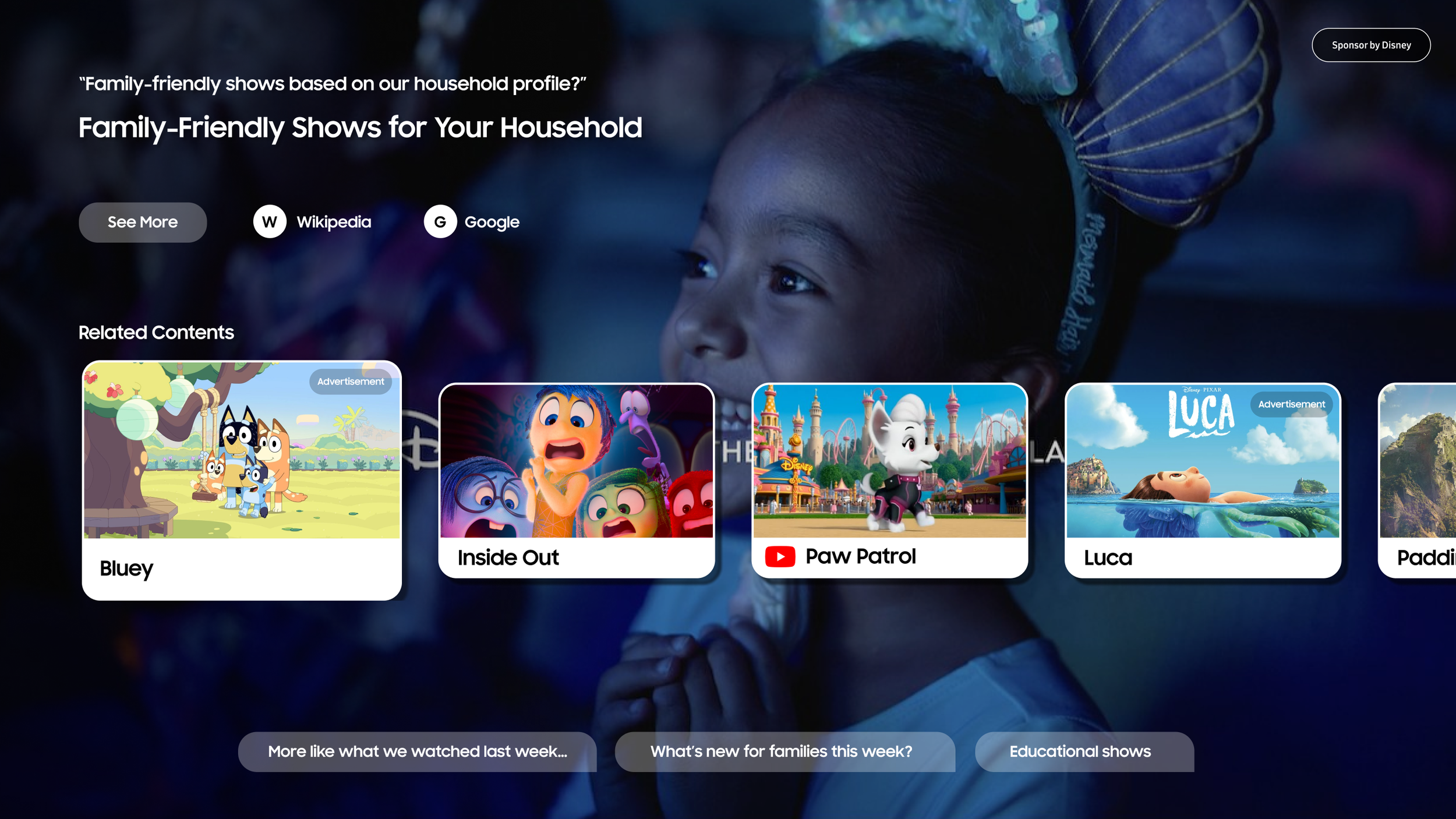
3. Select Pre-Populated Prompt: The user chooses the suggested prompt: “Family-friendly shows based on our household profile.”
-
![]()
4. Display AI Results with Sponsored Content: The AI returns results aligned to the prompt, accompanied by sponsor ads and related shows, with optional static ads displayed in the background.
Measurable Outcome
-
Designed for Scale, Not One-Off Experiences
Research reduced risk before engineering investment.
Tested sponsored vs. non-sponsored result acceptance
Evaluated comprehension, trust, and perceived value
Identified thresholds where ads became disruptive
Used findings to define clear guardrails for AI monetization
-
Business Impact
Established a new high-intent ad surface on TV
Increased advertiser relevance and confidence
Created a scalable foundation for AI-driven monetization
Positioned Samsung Ads to lead in AI-powered CTV experiences
“Vision AI demonstrates how intent-driven design, rigorous research, and platform thinking can unify user experience and monetization—without sacrificing trust.”.
— This work positions TV not just as a screen, but as an intelligent interface for the home.Thank you so much!
Explore My Other Projects
-
![]()
Enhancing Engagement Through Smarter Ad Design
Led a transformation of Samsung Ads’ interactive TV ad experiences—from replicating industry norms to defining a differentiated user-centric platform.
-
![]()
CPX Campaign – Powering Scalable Performance Growth.
Led the evolution of CPX into a scalable performance platform, expanding support for new ad formats and advertisers while maintaining operational efficiency and enabling real-time optimization.
-
![]()
Stay Safe, Stay Informed with Navify
Roche Information Solutions: Delivering Integrated Digital Solutions for the COVID-19 Era.
-
![]()
Brand Engagement with Fike
Created immersive marketing content and internal resources—from 3D visuals to white papers—that elevated brand engagement, strengthened team readiness, and reinforced strategic brand consistency.